Guides ·
Black bathroom grout: deep-clean it or regrout?
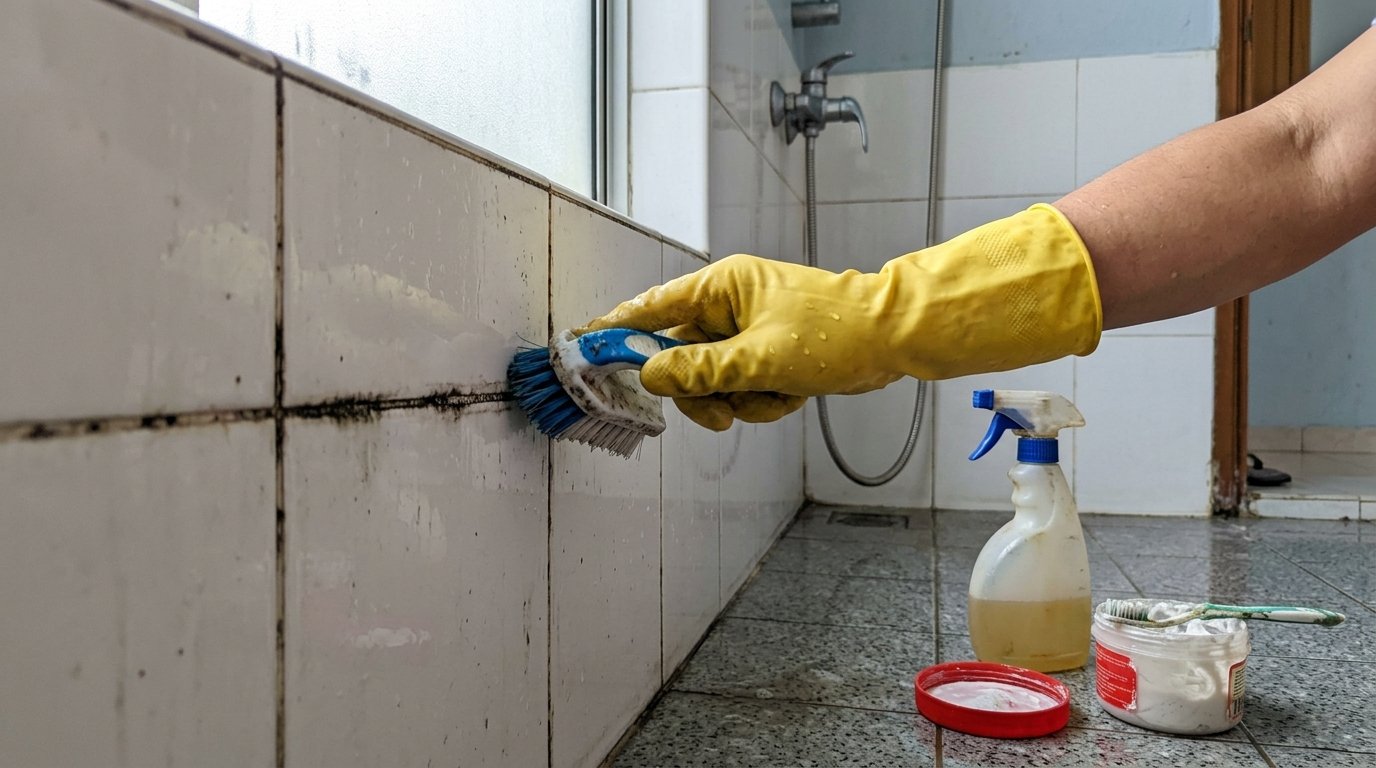
Here is the test that settles it in ten seconds. Drag a key or a flat screwdriver firmly along the blackest grout line. If the grout stays hard and smooth and all you get is a faint scratch mark, the grout is still sound — it is just stained, and a proper deep clean will bring it back. If the tip digs in, the line turns powdery or small crumbs come away, the grout has failed. No amount of scrubbing fixes that: it needs to be raked out and regrouted.
Why grout turns black here
Cement grout is porous. In a Malaysian bathroom that gets used for mandi twice a day and never fully dries, those pores stay damp around the clock, and mould feeds happily on the soap film trapped inside them. That is why the lines within a metre of the shower always go black first — they get wetted every day and dry the slowest.
There is a second, quieter failure in older houses. In 80s and 90s terrace bathrooms, grout was usually site-mixed white cement and water, with no additives at all. After 15–20 years that mix simply turns chalky, so a whole floor can scratch out powdery even where there is no mould in sight. If your scratch test crumbles everywhere, this is what you are looking at — not a cleaning problem.
Why bleach whitens it but does not fix it
Chlorine bleach kills the surface mould and strips the stain, so the line looks white again — for a while. But the pores are still pores. The next evening's mandi refills them with water and soap residue, and the black is usually back within weeks. Worse, repeated heavy bleaching slowly eats the cement paste itself. A better clean: mix oxygen bleach (sodium percarbonate powder) into a paste, leave it on the lines for 30 minutes, then scrub with a stiff nylon brush. Never a wire brush — it rakes soft grout straight out and scratches the tile glaze.
If the deep clean works, keep it working: squeegee the walls after mandi, leave the door or window open, and consider a penetrating grout sealer — honestly, expect it to last a year or two in a daily-use bathroom, not forever.
Regrouting: cement or epoxy?
| Cement grout (with additive) | Epoxy grout | |
|---|---|---|
| Material cost | Cheap, from under RM 20 a pack | Roughly 3–5 times more |
| Water absorption | Still porous; needs a sealer | Close to waterproof |
| Mould and staining | Can blacken again in a few years | Very resistant |
| DIY difficulty | Forgiving; mistakes are fixable | Short working time; dried haze is hard to remove |
| Finish | Matte, matches the original look | Slight plastic-like sheen |
Our honest recommendation: epoxy for the floor lines in the shower zone, where the punishment is constant, and a good additive cement grout plus sealer for walls and dry areas. Epoxy is excellent but unforgiving — it sets fast, and if you wipe late, removing the cured haze is miserable work.
Regrouting is cheap insurance for your waterproofing
Failed grout is usually the first open door for water into the screed under your tiles. The waterproofing membrane underneath is designed to cope, but constant saturation will eventually find any pinhole or weak corner — and once a yellow stain appears on the ceiling below, the cure is no longer grout. It is a re-waterproofing job at RM 1,500–5,000. Raking out and regrouting a bathroom, by contrast, is about a day's work and a few hundred ringgit. That gap is the insurance.
Want to DIY the regrout? The basics
- Rake the old grout out 2–3 mm deep with a grout saw (RM 10–20 at any hardware shop), then vacuum the lines clean.
- Work in small areas, pressing grout fully into the joints before moving on.
- Strike the lines flush with the tile edge. Sunken lines hold a film of water and never dry — they are why some regrouts go black again fast.
- Give it 24 hours before the bathroom is used, so plan the mandi arrangements first.
And if the scratch test crumbles across the whole floor, or there is already a stain on the ceiling below, it is worth having it looked at properly. We do this work across Serdang, Seri Kembangan, Balakong, Kajang, Bangi and Puchong — our price guide shows what the bigger jobs cost before you commit to anything.
Facing this problem at your home or shop?
WhatsApp us a photo — honest answer within 1 working hour. Serving Serdang, Seri Kembangan, Kajang & Puchong.
WhatsApp 013-940 0355