Guides ·
Leaking rusty zinc awning: patch it, coat it, or replace it?
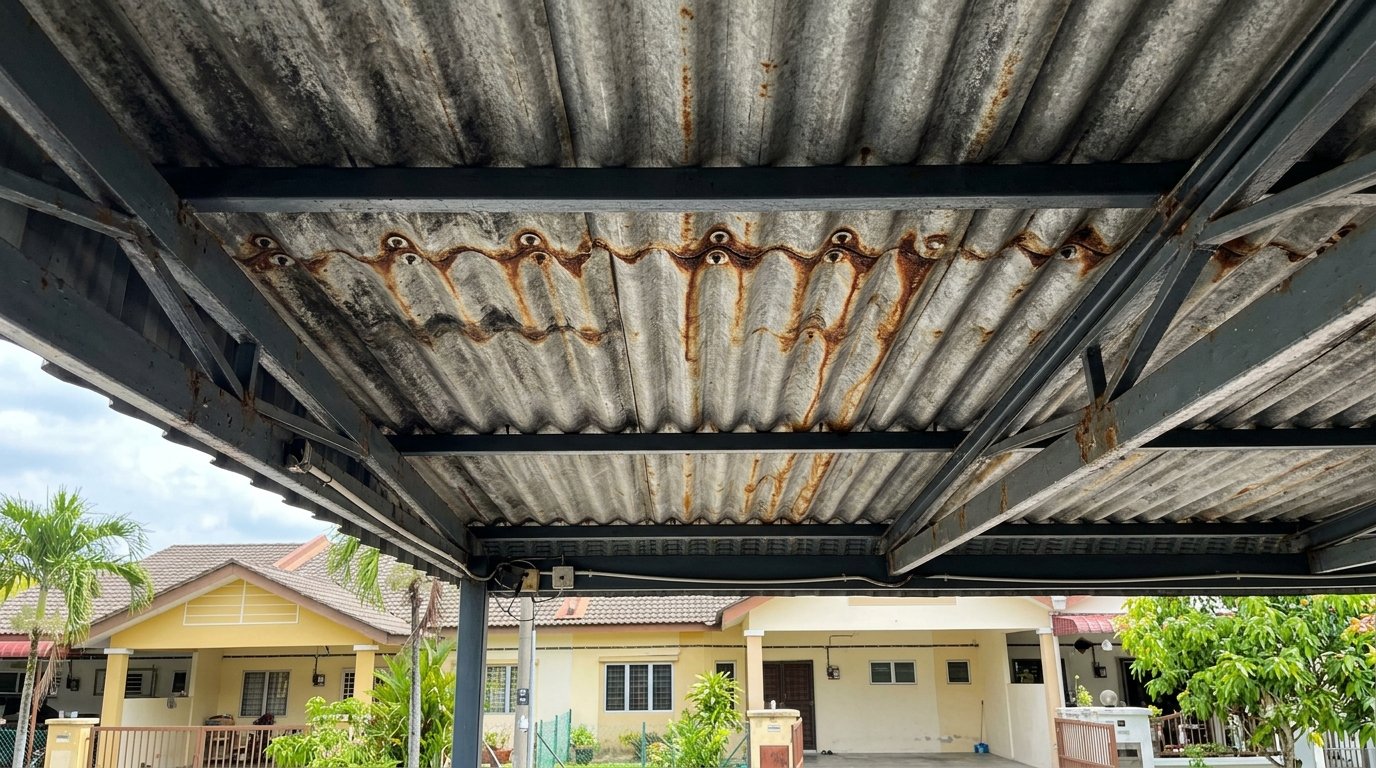
The short answer comes from a screwdriver. From a ladder, press the tip firmly against the rustiest spots on the underside of the awning. If the metal is still solid and the drips only appear at screws and sheet overlaps, patching or coating will buy you years for a few hundred ringgit. If the tip sinks in, or you can see daylight through pinholes, stop buying sealant — the sheet itself is finished, and anything short of replacement becomes a yearly ritual.
Why zinc awnings always leak in the same places
Walk under any older car porch or back-kitchen awning in the Serdang belt and the rust streaks tell one story, repeated house after house:
- Screw points first. Every roofing screw is a hole in the roof, sealed only by a small rubber washer. Under Malaysian sun those washers go hard and crack within five to eight years — long before the sheet itself fails. Most "mystery drips" are nothing more than a perished washer.
- Overlap joints. Where two sheets lap, wind-driven rain and capillary action pull water sideways into the joint. The flatter the awning, the worse it gets — which is why the low-pitch awning over the back kitchen usually leaks years before the car porch does.
- Ponding on sagging sheets. Old zinc sags between purlins, rain sits in the hollows, and rust eats from the top down exactly there.
- The wall joint. Where the awning meets the house wall, cracked flashing cement lets water run down behind — often blamed on the sheets when the sheets are fine.
One safety rule before anything else: never climb onto an old zinc awning. Rusted sheets can look intact and still fail under a person's weight. Work from a ladder at the edge, or leave it to someone with proper planks and know-how.
Option 1: patch the leak points — RM 100–500 territory
If the metal passes the screwdriver test, the right patch is mechanical, not a smear of silicone. Old screws come out and are replaced with self-drilling screws one size up, with fresh bonded washers that seal the enlarged hole. Leaky overlaps get butyl flashing tape pressed into clean, dry metal — butyl stays sticky and moves with the sheet, which is why it outlasts silicone by years. A tube of clear sealant wiped over a dusty, rusty, flexing sheet peels within months; that is the patch most houses have already paid for twice. Done properly, screw and overlap patching on a typical awning fits comfortably inside a normal RM 100–500 handyman visit, and pairs well with other small jobs in the same trip — see our services.
Option 2: rust-convert and coat — the middle road
Surface rust across large areas, but solid metal underneath? Then the whole sheet can be saved: wire-brush the loose rust off, apply a rust converter (it turns the brown oxide into a stable black layer instead of pretending to remove it), then roll on a fibre-reinforced acrylic or bitumen roof coating over everything — screws, laps and all. The coating is only as good as the prep, which is the part DIY jobs usually rush. Materials for a typical car-porch awning run a few hundred ringgit; done for you, expect the upper half of the handyman range or a small quote of its own. A good coating buys five years or more on honest metal — and nothing at all on metal that already flexes.
Option 3: replace the sheets
| Material | Character | Rough lifespan |
|---|---|---|
| Plain zinc | Cheapest, hottest, noisiest in rain | 10–15 years |
| Colour-bonded metal deck | Cooler, neater, small extra cost — the usual default today | 15–25 years |
| Polycarbonate / uPVC (Alderon-type) | Lets light through, no rust, quieter; frame must be straight | 10–20 years |
If the steel frame is still sound, re-sheeting a back-kitchen awning is often a low-thousands job; a full car-porch awning with frame repairs sits meaningfully higher, and an honest quote will price the frame and the sheets separately. Which brings up the part most quotes skip: hollow-section frames rust from the inside, at the joints and at the bottom of posts where water sits in the tube. Press those spots too — new sheets on a rotten frame is money thrown upward.
The honest decision path
- Drips only at screws or laps, solid metal → patch it, and spend the savings elsewhere.
- Widespread surface rust, solid metal → convert and coat, once, properly.
- Pinholes, flaking layers, soft spots, or a sagging frame → replace; every ringgit spent on sealant first is wasted.
If you are not sure which category your awning is in, that screwdriver test takes five minutes on a dry morning — and our price guide shows how small-repair visits are charged so you can compare patching against replacing with real numbers.
Facing this problem at your home or shop?
WhatsApp us a photo — honest answer within 1 working hour. Serving Serdang, Seri Kembangan, Kajang & Puchong.
WhatsApp 013-940 0355