Guides ·
Holes and dents in partition walls: patching gypsum and plywood so it stays invisible
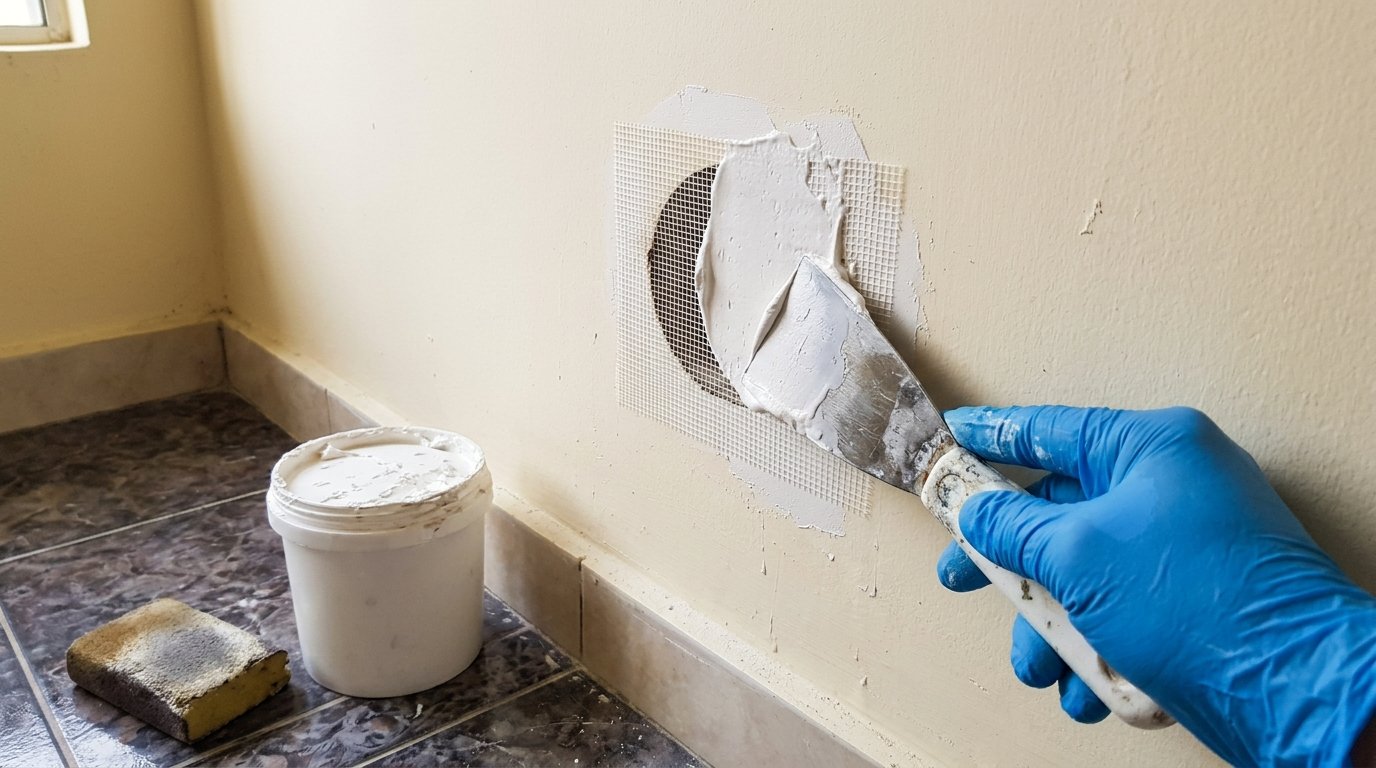
Straight answer: a hole up to about 8 cm in a gypsum partition is fixed with a self-adhesive mesh patch and three thin, feathered coats of joint compound, then sanded, primed and painted. Anything bigger gets cut back to a clean square, a timber backing strip screwed inside, a new piece of board fitted, taped and skimmed. Whether it stays invisible depends less on the filler than on the paint: patches show because of sheen, not colour, so budget for repainting that wall corner to corner.
This is one of the most common small jobs we get called to in Serdang-belt terraces and shoplot upper floors: the doorknob hole behind a bedroom door, the screw holes where a TV bracket was, and the torn-paper scar from a removed kitchen cabinet. All three are handyman work, around RM 100–300 for several patches in one visit, repainting extra.
Why the toothpaste-and-paint patch cracks out in weeks
Filling a hole flush with wall putty, toothpaste or caulk puts nothing behind the hole. The filler is held only by its edges, it shrinks as it dries, and the first time the door swings or the wall flexes, a ring crack appears and the plug falls into the cavity. Gypsum board is paper over a chalk core; once the paper is torn, the core has no strength. The repair has to bridge the hole with something that is bonded to sound paper on all sides.
Small holes: mesh and compound
- Cut away loose paper and press any crushed edge inward so nothing stands proud of the surface.
- Stick a fibreglass mesh patch over it, overlapping the hole by at least 3 cm all round. Press the edges firmly.
- Spread a thin coat of joint compound through the mesh with a wide knife. Thin is the point: a thick coat cracks.
- Dry, then a second coat spread wider. Then a third, wider again, until the edge feathers to nothing at roughly 25–30 cm across.
- Sand lightly with a sponge block, wipe the dust, and prime the patch before painting.
Use proper joint compound or a fine skim coat, not cement-based wall putty, which is too hard for board and cracks along the edge. Each coat here takes a few hours to dry in our humidity; rushing coat two over a wet coat one is the usual reason a patch sinks later.
Big holes: cut a square and back it
For anything you can fit a fist through, mesh alone sags. Mark a square around the damage, cut it out with a drywall saw, and screw a strip of timber or a spare piece of board inside the cavity so it bridges the opening. Screw the new square of gypsum to that backing, tape the four joints, then skim in three coats exactly as above. If the hole sits beside a metal stud, cut back to the stud centre and screw straight into it, which is stronger than any backing strip.
Plywood partitions are different
Older shoplots and some 1990s terraces around Seri Kembangan and Balakong have plywood or thin timber-board partitions instead of gypsum. Screw holes take wood filler. Larger damage is cut to a clean rectangle and a matching plywood piece glued and pinned onto battens behind, then the whole panel is sanded. Plywood also drinks paint unevenly, so prime the whole panel, not just the patch.
Why a good patch still shows
The patch outline you see in afternoon light is almost never a colour difference. It is a sheen difference: fresh compound is porous and flat, the surrounding paint is faded and slightly glossier, and light raking across the wall from a window picks out the boundary. Three things fix that: prime the patch so the top coat does not flash, use the same finish (matt, low sheen or silk) as the existing wall, and paint the whole wall to a natural break, usually corner to corner. Spot-painting a 30 cm circle in a new tin of the ‘same’ colour is how you turn one patch into a bigger one.
Do not hang heavy things back into a patched spot
A patch has no structural strength. If a TV bracket or a wall cabinet is going back up, it goes into the studs or into proper hollow-wall anchors, never into the patched area:
| Load | Gypsum board | Plywood partition |
|---|---|---|
| Picture, clock, small shelf | Plastic hollow-wall plug or self-drilling anchor | Wood screw straight in |
| Bathroom cabinet, curtain rail, coat hooks | Toggle or butterfly anchor | Wood screw into batten behind |
| TV bracket, kitchen wall cabinet, grab bar | Screws into the metal or timber stud only | Screws through into stud or batten only |
Studs in Malaysian partitions are usually metal C-channels around 600 mm apart. A cheap magnet dragged along the wall finds the screw heads and therefore the stud line; a stud finder app on a phone is far less reliable. Fit a door stopper behind the bedroom door too, or the same doorknob makes the same hole again.
Landlords: patch between tenants, not after complaints
For rental units, wall damage is one of the most common deposit arguments. Photograph every hole at move-out, patch and repaint before the next viewing, and bundle it with the other small fixes in a single visit. That is exactly what our landlord package covers, and small jobs like this sit under handyman in our services.
Facing this problem at your home or shop?
WhatsApp us a photo — honest answer within 1 working hour. Serving Serdang, Seri Kembangan, Kajang & Puchong.
WhatsApp 013-940 0355