Guides ·
Outdoor security and sensor lights: what works on a Malaysian porch and what fails fast
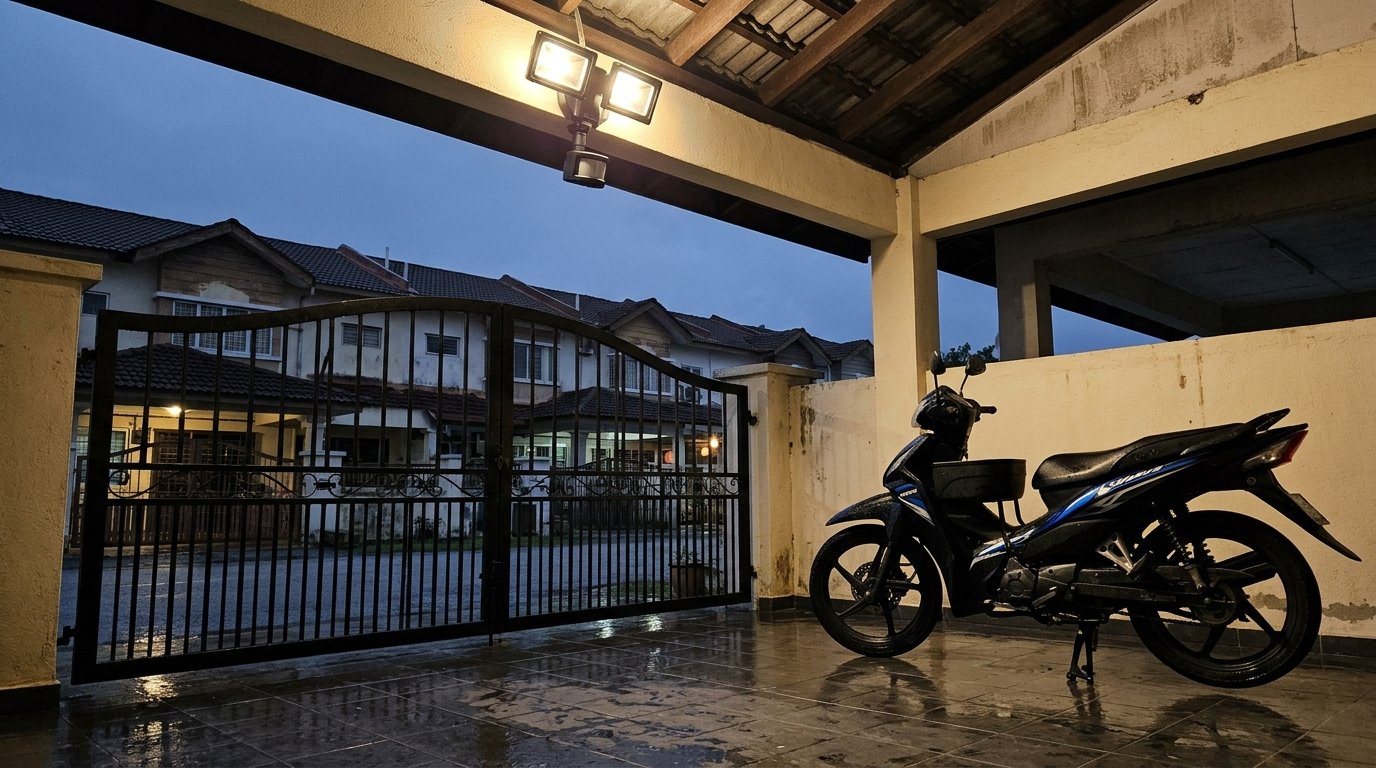
Straight answer: the outdoor light that actually lasts on a Serdang-belt porch is a wired LED fitting rated at least IP65 if it sits on an exposed wall (IP44 is enough under a porch ceiling), with its PIR motion sensor mounted around 2.2–2.5 m up and aimed so people cross its view rather than walk straight at it. What fails fast is the all-in-one solar floodlight screwed under the eaves, and any sensor pointed at the road, a tree or the aircond outdoor unit. Wiring a new point is carried out with our licensed partner contractor, Suruhanjaya Tenaga compliant, at roughly RM 80–600 per point depending on the cable run.
Most ‘this sensor light is rubbish’ complaints we hear on terrace rows in Seri Kembangan and Kajang are not about the fitting. They are about where it was screwed and which way it was pointed.
Why cheap sensor lights go off for rain and cats
A PIR sensor does not see movement. It sees a warm object crossing from one detection zone into the next, so anything that changes temperature across its view triggers it:
- Rain: a sun-warmed porch floor or wall suddenly cooling under a downpour reads as movement, and water droplets on the sensor lens scatter heat signatures. A sensor facing open sky with no hood above it is the worst case.
- The aircond outdoor unit: a condenser kicking on blows a plume of hot air. If the sensor can see the unit, the light comes on every cycle all night.
- Cats on the wall: at 1.8 m mounting height a cat on the boundary wall is a big warm target. At 2.4 m, aimed downward, it falls out of the zone.
- The road: a sensor that can see passing cars on the main road never rests. Angle it so the detection edge stops at your gate.
The fix is nearly always the same: raise the fitting, tilt the sensor down, and turn the sensitivity dial (marked SENS) down from maximum, which is where every unit ships. The second dial (TIME) set to 1–2 minutes is enough for a porch; the LUX dial decides at what darkness it starts working.
Mounting height and aim
A PIR is most sensitive to movement across its zones. Someone walking straight towards it from the gate gets detected late, sometimes only at the porch step. Mount it on the porch side wall or pillar so the path from gate to door runs sideways past it. On a standard terrace that means the house wall nearest the gate, not centred over the door.
Exposed wall or under the porch ceiling?
| Location | Rating needed | What we check |
|---|---|---|
| Under porch ceiling or awning | IP44 and above | Fitting out of direct splash, cable entry sealed |
| Exposed front wall or side lane | IP65 and above | Gasket intact, cable enters from below, fitting tilted so water runs off the lens |
| Back lane facing the drain | IP65, hooded sensor | Sensor cannot see the warm drain or the neighbour’s kitchen exhaust |
One detail the box never mentions: on end-lot terraces the gable wall takes wind-driven rain sideways, and even IP65 fittings fail there if the cable enters from the top. Water follows the cable into the terminal block, so we always bring it in from underneath.
Cover the gate and car, not the neighbour’s bedroom
Terrace porches are small. A 10–20 W wide-beam LED aimed down at about 30–45 degrees lights the gate, car and porch step with no dark corners. A 50 W flood pointed outward blinds the neighbour across the road and turns your own gate into a silhouette.
For the side lane between houses, a small dusk-to-dawn fitting with a photocell often beats a motion light. It stays on at low wattage all night, so the lane is never dark between triggers, and a photocell has nothing to false-trigger on.
Solar vs wired, honestly
| Solar all-in-one | Wired LED with PIR | |
|---|---|---|
| Install | Two screws, no electrician | Cable run and connection via licensed partner |
| Brightness after 1 year | Noticeably weaker: haze dust on the panel, battery cooked in a hot box | Same as day one |
| Under eaves or porch ceiling | Panel gets almost no sun, dies first rainy week | Works anywhere |
| Realistic lifespan | 1–2 years | 5+ years, bulb-less LED |
| Cost | RM 30–150, repeated | RM 80–600 per point once, fitting extra |
Solar only makes sense where the panel gets full sun all day and there is no cable route, like a far garden corner. For the porch and gate, wired wins.
The switch trap
If the sensor light is wired through the old porch switch, every time someone flicks it off and on the sensor resets, and on many units that puts it into a permanent-on test mode for a minute or more. Tape the switch on, or better, have the circuit arranged so the sensor is fed directly. That is wiring work, so it goes through our licensed partner contractor, Suruhanjaya Tenaga compliant. Never run an indoor extension through the window grille for this.
What it costs
A fitting replacing an existing porch light on its old cable sits at the bottom of the RM 80–600 range. A new point across the porch to the gate pillar, with conduit, sits higher. It bundles well with other small jobs in one visit: see where electrical work sits in our price guide and the full list under services.
Facing this problem at your home or shop?
WhatsApp us a photo — honest answer within 1 working hour. Serving Serdang, Seri Kembangan, Kajang & Puchong.
WhatsApp 013-940 0355