Guides ·
Switching to an induction cooker: can your house wiring actually take it?
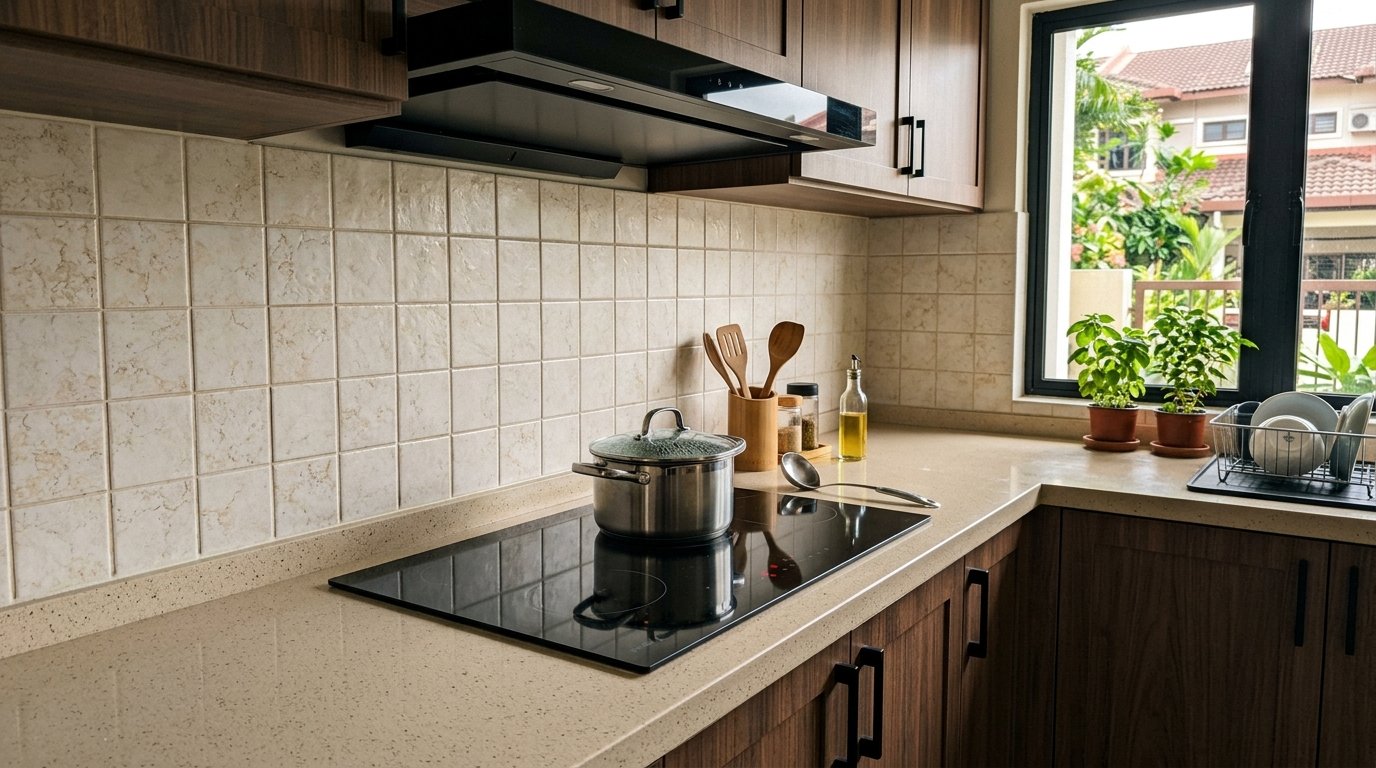
Direct answer: a portable single-zone induction cooker with a moulded 13A plug works fine on any kitchen socket in good condition. A built-in hob with two or more zones does not — it draws between 4kW and 7.4kW, more than double what a 13A socket can legally supply, and it needs its own dedicated circuit run from the distribution board. In the gas-stove-era terrace houses around Serdang, Seri Kembangan and Kajang, that circuit almost never exists yet, because nobody needed it when the house was wired.
Read the rating plate before you buy
Every induction unit states its total power on the carton and on a plate under the body. The dividing line is simple: a 13A plug tops out at about 3kW. Below that, with a factory-fitted plug, you can plug in and cook tonight. Above that, the hob must be hard-wired — no plug exists for it, and any seller who offers to “just fit a plug” is telling you to overheat a socket.
One thing worth knowing: many built-in hobs have a power-management setting that caps the whole hob at 13A so it can run from a socket. It is a genuine manufacturer feature, not a hack — but it means boost mode throttles and two zones cannot run hot at once. Fine for soups and simmering; frustrating if you bought induction for fast wok-style heat.
Why the old kitchen socket cannot take it
In the 1980s and 90s terraces we work in, the kitchen sockets usually share one circuit that was sized for a fridge, a kettle and a rice cooker. The first thing a contractor finds in these kitchens is that the socket has been extended and tee’d over the years — an extra point for the microwave here, one behind the cabinet there — so the circuit is already carrying more than its designers planned before the hob even arrives. A full-size hob needs a much heavier cable of its own, straight from the distribution board, with a double-pole isolator switch beside the hob. A gas-era kitchen has none of that.
Warning signs the circuit is already struggling
- The plug face or socket is warm to the touch after cooking, or shows brown discolouration around the pins.
- A smell of hot plastic in the kitchen after a long cooking session.
- The breaker trips at dinner time, when the cooker, kettle and fridge compressor all run together.
- Lights dim for a moment when a zone switches to full power.
Safety note: heat at a plug is the early stage of a failing connection. If you see any of these, stop running the cooker on that socket now — and do not move it onto an extension lead or multiway adapter, which only moves the heat somewhere you cannot see it.
What a proper installation involves
All wiring work we arrange is carried out by our licensed partner contractor and is Suruhanjaya Tenaga compliant — this is one of the jobs we will not DIY and neither should you. The job itself is straightforward: a dedicated circuit from the distribution board in the correct cable size, its own breaker with RCD protection, and an isolator beside the hob. With a spare way in the board it is a half-day visit. If your board is already full or is an old unit with no spare protection, the honest answer is that the board needs attention first — better to hear that before the hob is sitting in its box.
Honest costs
| Situation | Wiring cost |
|---|---|
| Portable 13A plug-in cooker, healthy socket | RM 0 — just plug in |
| Dedicated hob circuit, distribution board nearby, spare way available | Roughly RM 250–400 |
| Long or concealed cable run, or extra protection needed in the board | Up to about RM 600 |
Those figures sit inside our normal electrical range — see the price guide for how we quote, and the rest of what the team covers under services. If a quote for a simple circuit run comes in far above this, ask what the extra is paying for.
Facing this problem at your home or shop?
WhatsApp us a photo — honest answer within 1 working hour. Serving Serdang, Seri Kembangan, Kajang & Puchong.
WhatsApp 013-940 0355