Guides ·
Popped or bulging floor tiles: why it happens and the real fix
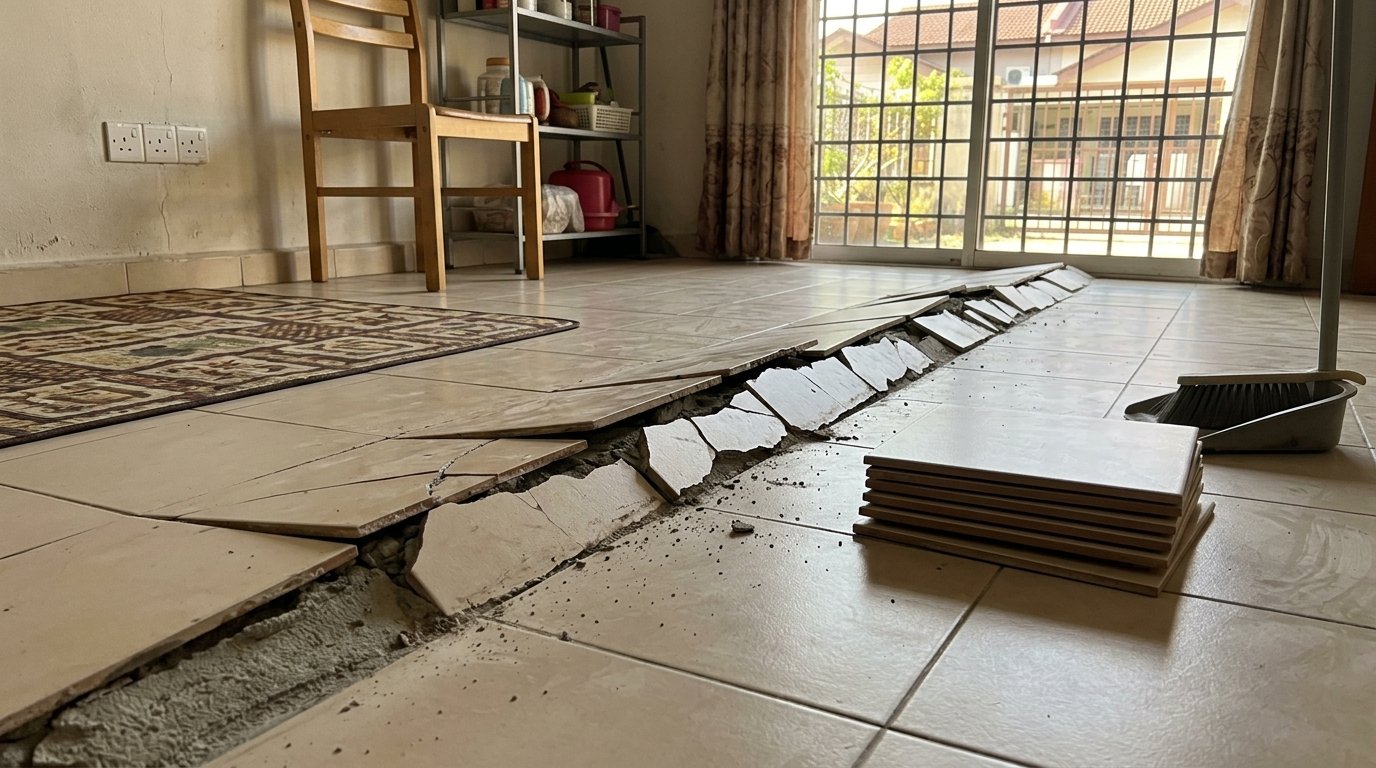
The short answer: tiles pop because stress has been building between the tiles and the concrete underneath for years, and one hot afternoon it finally lets go — sometimes with a bang loud enough to wake the whole house. The tiles were usually laid too tight, with adhesive covering only part of each tile's back, and the Klang Valley's daily heat-up-then-rain-cool-down cycle did the rest. Gluing the same tiles back down is a short-term patch; the real fix is re-laying the affected area properly, and it costs less than most people fear.
Why it happens
- No expansion gaps. Floors in many older terrace houses around Serdang and Kajang were tiled edge-to-edge, hard against every wall, with no movement joints. The concrete slab expands slightly in afternoon heat; the tiles have nowhere to go, so compression builds across the whole floor like a spring being wound.
- Spot-bonding adhesive. The old "five dabs" method — a blob of adhesive at each corner and one in the middle — was standard practice for decades. When we lift a popped tile, the back tells its whole story: five round biscuit marks and 60% bare tile means it was never fully bonded from day one, and it was only a matter of time.
- Screed or slab movement. Sometimes the adhesive is fine but the sandy screed layer under it has sheared. If a lifted tile comes up with a crust of grey screed still stuck to it, the weakness is a layer deeper — and re-sticking the tile onto the same crumbly base will not hold.
This is why tiles tend to pop during a hot spell, and often at night as the slab cools and contracts. And why they go in a chain: once one row releases, its stress transfers straight into the neighbouring rows.
What to do the moment it happens
- Keep feet and kids away. Popped edges are genuinely sharp, and a bulging section can crunch down suddenly when stepped on.
- Lift out fully loose tiles and stack them flat somewhere safe. If your tile design has been discontinued — very likely in a 20-year-old house — intact originals may be reusable, and matching old tiles is honestly the hardest part of the whole repair.
- Tape a sheet of cardboard over the area so nobody forgets it's there.
- Don't inject glue or silicone under a bulge. It seals the gap without restoring the bond, and it makes the proper repair messier and more expensive.
Temporary fix vs the real one
| Approach | What's done | Honest verdict |
|---|---|---|
| Re-stick the popped tiles | Old adhesive scraped off, same tiles glued back | Acceptable stopgap, but the stress that popped them is still in the floor — edges of the patch often go next |
| Re-lay the affected section | Hack back to solidly bonded tiles, full-coverage adhesive, a proper movement gap added | The right repair for most cases — releases the stress instead of fighting it |
| Redo the whole floor | Everything up, screed checked, new tiles | Only worth it when tapping reveals hollow sound across a third of the floor or more |
Cost depends almost entirely on the area involved and whether your tile design still exists. A small popped section is typically handyman-scale work in the low hundreds of ringgit; a full floor is a renovation-scale job quoted by area and tile choice. Our price guide shows how we band these, and a photo of the damage is enough for us to give a straight answer on which category you're in.
Danger signs that mean don't wait
- A ridge or "tent" line creeping across the room. That stress hasn't released yet. Having a section lifted early, on your schedule, beats a midnight bang and a floor full of shards.
- A straight crack running through several tiles in a line. That's usually slab or settlement movement, not adhesive — a different problem that's worth a proper look before any retiling.
- Popped or hollow tiles in an upstairs bathroom. Special case — read on.
Bathroom floors are a different story
Hollow bathroom tiles are rarely just heat. Water that has crept under the tiles attacks the adhesive from below, so a hollow bathroom floor often means moisture is already sitting on top of the waterproofing membrane — or has got past it. And because hacking up a bathroom floor disturbs that membrane, any honest repair must include re-waterproofing and a 24-hour ponding test before the new tiles go down — that's RM 1,500 – 5,000 depending on the bathroom. Any quote that offers to retile a bathroom floor without redoing the membrane underneath is leaving the actual problem in place, nicely hidden under fresh tiles.
Facing this problem at your home or shop?
WhatsApp us a photo — honest answer within 1 working hour. Serving Serdang, Seri Kembangan, Kajang & Puchong.
WhatsApp 013-940 0355