Guides ·
Termite-eaten door frames: repair, replace with timber, or switch to aluminium?
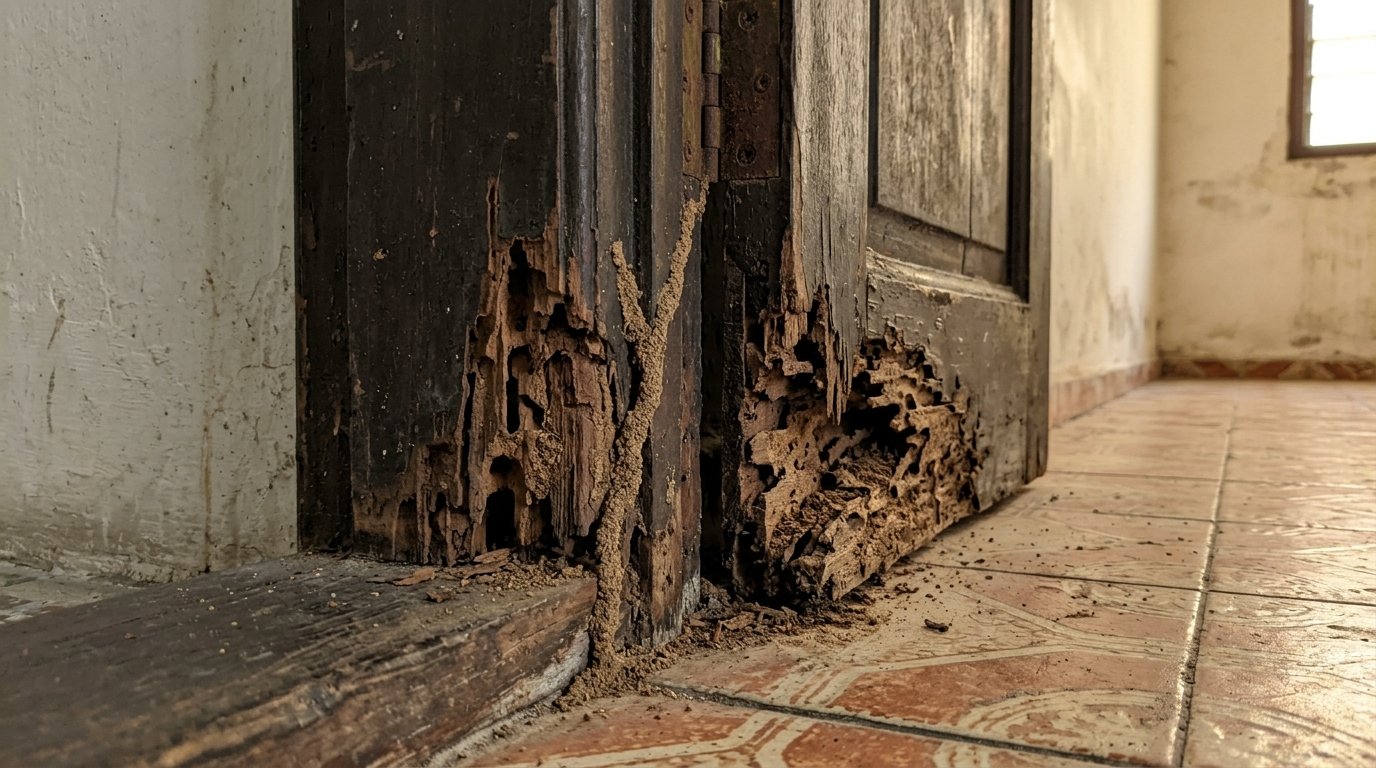
The honest answer up front: press a flat screwdriver into the bottom 30 cm of the frame. If the tip sinks in under light hand pressure, patching is over — that frame is hollow and needs replacing. If it only flakes at the surface, you can treat and fill. But either way, do nothing to the wood until the termite trail feeding on it has been dealt with. Fit a beautiful new frame over an active trail and you have simply restocked the colony’s pantry — we have seen replacement frames eaten through again within two years.
Find out how bad it really is
- The tap test. Knock along the frame with a knuckle or screwdriver handle, low to high. Solid timber answers with a sharp knock; eaten sections sound papery and hollow, like a drum. The change point tells you how far up the damage runs.
- Probe the bottom 30 cm. Subterranean termites come up from the soil, so damage concentrates at the base and climbs. A frame that is solid at knee height is usually salvageable.
- Check the hidden face. Termites often eat the back of the frame where it meets the brickwork, leaving the painted face intact — they eat up to the paint skin and stop. A frame can look perfect and crumple under a thumb. Hinge screws pulling loose for no reason are another giveaway: the wood behind them is gone.
- Look for mud tubes — pencil-width earth trails along the skirting, the wall edge of the frame, or inside the shoe cabinet beside the door.
Why treating the frame alone wastes money
The termites in your frame are commuters; the colony lives in the ground. Spraying the visible damage kills the workers present that day and nothing else — the trail reroutes and reappears a metre away. What actually works is treating the route: soil treatment or baiting by a pest-control specialist, then carpentry after. In older Serdang and Kajang terraces we sequence it exactly that way — pest treatment first, new frame a week or two later — because doing it in the other order throws away the carpentry.
Patch, new timber, or aluminium?
| Option | Typical cost | When it makes sense |
|---|---|---|
| Fill, sand and repaint | RM 50–150 as handyman work | Surface galleries only; frame still solid to the probe |
| New hardwood frame, sealed all faces | RM 350–700 installed | Bedroom and living-area doors; keeps the timber look |
| Aluminium frame | RM 500–900 installed | Bathroom and wet-kitchen doorways — nothing to eat, nothing to rot |
Two notes from the workshop side. First, the door itself often survives even when the frame is gone — doors hang clear of the soil route — so quote-checking matters: you may only need the frame. Second, if you do go back to timber, insist the new frame is sealed on all faces including the back and the cut ends before installation. The factory primer on the visible faces is not what protects it; the bare back against damp brickwork is where both rot and the next attack start.
When to call a pest specialist before any contractor
Replace-and-move-on thinking fails when the frame is just the visible tip. Go to a pest-control company first if you see damage or mud tubes near the ceiling or roof trusses, if several rooms are affected at once, or if winged termites swarm indoors after rain. Roof timber is structural — that inspection outranks any door frame. And if a neighbouring unit was recently treated or renovated, be extra alert for a season: displaced colonies move along the terrace row to the next untreated house.
Once the trail is dead, the carpentry is a straightforward one-day job per door, and it bundles well — frames, a swollen door, loose hinges elsewhere — into a single visit. Our services page covers the small-carpentry side, and the price guide shows where frame work sits in the ranges.
Facing this problem at your home or shop?
WhatsApp us a photo — honest answer within 1 working hour. Serving Serdang, Seri Kembangan, Kajang & Puchong.
WhatsApp 013-940 0355