Guides ·
Buying a new toilet bowl: S-trap, P-trap and rough-in distance explained
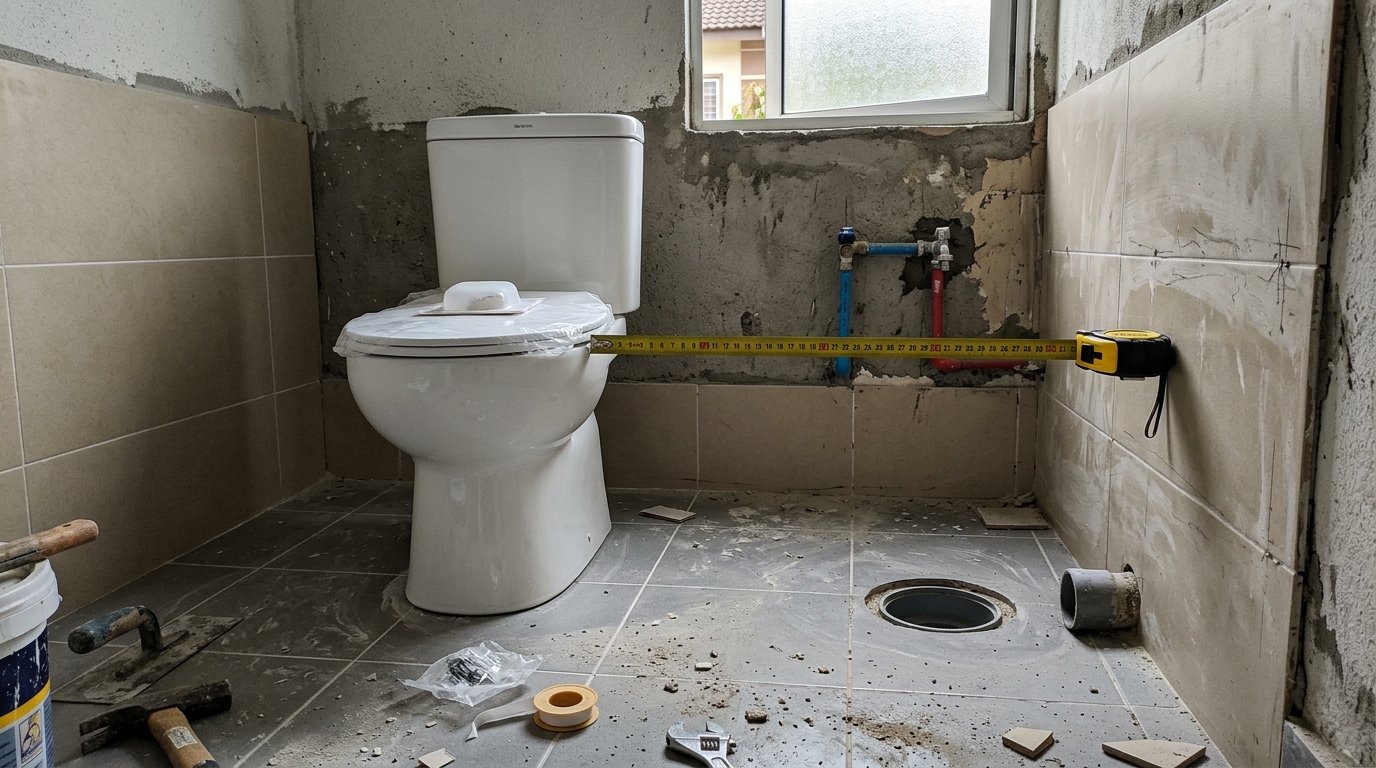
Straight answer: before you pay for any toilet bowl, you need two facts about your bathroom — whether the waste pipe leaves through the floor or through the wall, and how far the centre of that pipe sits from the finished wall. The first decides whether you need an S-trap or P-trap bowl; the second is called the rough-in distance. Get either one wrong and the new bowl simply will not line up with the pipe, no matter how good it looked in the showroom. We see this almost every month around Serdang and Seri Kembangan: someone buys a bowl on promotion, the plumber arrives, and the job stops right there.
The good news: both checks take five minutes with a measuring tape, and a straightforward like-for-like swap sits comfortably in normal plumbing territory — RM 100–500 for the labour, plus the bowl itself. The expensive version of this story only happens when the outlet has to move.
S-trap or P-trap: look at where the pipe goes
An S-trap bowl discharges straight down through the floor. A P-trap bowl discharges horizontally through the wall behind it. Most landed houses in the Serdang belt — terrace houses in Seri Kembangan, Balakong, Kajang and Bangi — are S-trap, because the soil pipe drops through the floor slab. P-trap turns up more in apartments and some shoplots, where the pipework runs in the ceiling void of the floor below.
If the old bowl is still installed, look behind it. A pipe entering the wall means P-trap. Nothing visible and the bowl sitting flat on the floor means almost certainly S-trap. The two are not interchangeable: adaptor bends exist, but every extra bend weakens the flush and adds a joint that can leak underneath the bowl — exactly where you will never see it until a stain appears on the ceiling below.
Rough-in: the measurement everyone skips
For an S-trap bowl, the rough-in is the distance from the finished wall (the tile surface, not the bare brick) to the centre of the floor outlet. In Malaysia you will mostly meet 250 mm and 300 mm bowls, but older houses can surprise you — we have measured anything from 200 to 400 mm, because the original plumber put the pipe wherever was convenient that day.
Measure with the old bowl removed if you can. If not, measure from the wall to the fixing-bolt caps at the base and treat it as an estimate. Two trade habits worth copying: measure from the tile, never from the skirting, and measure twice — a bowl that lands 30 mm off cannot simply be “pushed back a bit”. An offset connector can shift the connection by 40–50 mm, but it narrows the passage, and that narrow point is where blockages start. For a P-trap bowl, the number that matters instead is the height of the wall outlet centre from the floor — commonly around 180 mm.
Wash-down vs siphonic: an honest comparison
| Wash-down | Siphonic | |
|---|---|---|
| How it flushes | Water pushes waste out directly | Suction pulls waste through a long trapway |
| Blockage risk | Lower — short, wide trapway | Higher — long, narrow trapway |
| Noise | Louder splash | Noticeably quieter |
| Water surface | Smaller — needs brushing a little more often | Larger — bowl stays cleaner |
| Water use | Very efficient with 3/6 L dual flush | Slightly more per flush |
| Price | Cheaper | More expensive |
Our honest take for most homes: a decent wash-down bowl is the sensible choice, especially in households with young children, because the short wide trapway forgives what gets flushed. Siphonic feels premium and quiet, but that long narrow trapway is less forgiving — and a blocked siphonic bowl is a harder bowl to clear.
Why the cheapest bowls cost more later
The difference between a RM 200 bowl and a RM 400 one is mostly in the glaze and the fittings. Thin glaze goes dull and starts staining within a couple of years, and once cleaning powder has scratched it, the stains never fully come out. Budget seat hinges and flush mechanisms are usually the first things to break. Spending RM 100–200 more at the shop is cheaper than hating your toilet for a decade.
What the job costs
If the trap type and rough-in both match, a swap is a half-day plumbing job: RM 100–500 labour plus the bowl. If the outlet has to move, the floor must be hacked open and the pipe relocated — and that disturbs the floor’s waterproofing layer, which then has to be redone properly. At that point you are into bathroom-refresh territory, so check our price guide before committing to a bowl that forces the issue.
Not sure whether yours is S or P, or can’t find the outlet centre? WhatsApp us a photo of the back of your bowl and your tape measurement — we can confirm what to buy before you spend anything, or handle the whole swap through our plumbing service.
Facing this problem at your home or shop?
WhatsApp us a photo — honest answer within 1 working hour. Serving Serdang, Seri Kembangan, Kajang & Puchong.
WhatsApp 013-940 0355