Guides ·
Auto gate acting up after rain: motors, limit switches and what's actually fixable
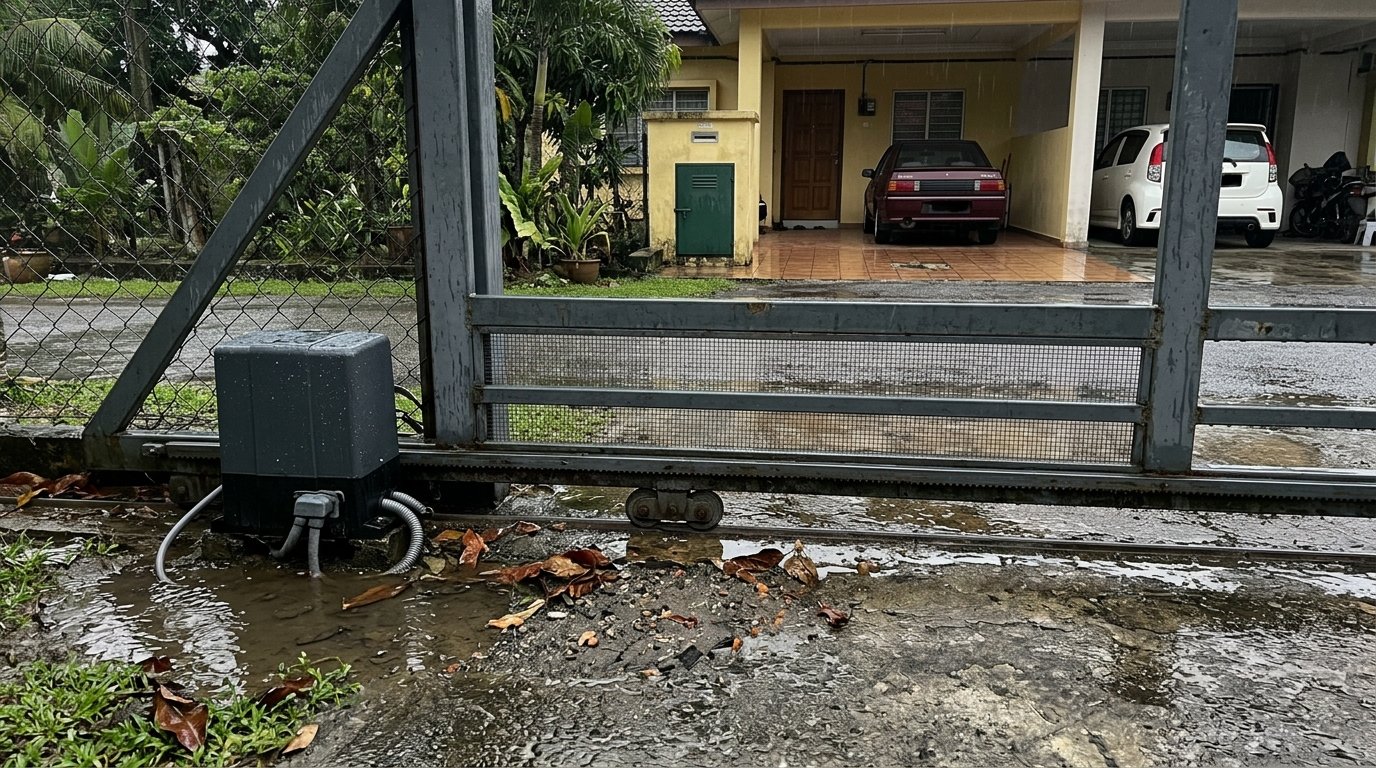
Straight answer: when an autogate starts misbehaving right after a storm, the cause is almost always one of three things — water sitting in or around the motor housing, a limit switch that has corroded or shifted so the gate overruns or stops short, or a remote that has lost range because its battery is dying. Only one of those is a genuine electrical repair; the other two are a drying-out job and a RM 10 battery. Run the checks below before anyone quotes you a new motor set.
One rule first: switch the gate off at the isolator or the breaker on your distribution board. A wet motor housing with live terminals is not something to poke with a screwdriver.
First: make sure the gate can still be pushed
Every autogate has a manual release — a key or lever on the motor that disengages the gearbox so the gate can be moved by hand. In a blackout, or when the motor is flooded, that release is how you get the car out. If it is seized from years of rust, fix that first: a gate you cannot open by hand traps you in your own porch. Penetrating oil usually frees it; a snapped release key means a cheap new lock barrel.
Water in the motor pit
Underground swing-arm motors sit in a steel box set into the driveway slab. Those boxes are supposed to have a drain outlet, and on many older installations around Seri Kembangan and Balakong it was never connected or has silted up. After an afternoon storm the box fills, the motor sits in water, and the gate refuses to move or moves jerkily until it dries. Sliding motors suffer the same way when their base plate sits in the porch’s low spot.
Open the lid and look. If there is standing water, bail it out, leave the lid off for a day to dry, then clear the drain hole with stiff wire. If the pit floods every time it rains, the fix is drainage, not a new motor — a proper outlet to the roadside drain, or a concrete plinth that lifts a sliding motor above the water line. That is handyman work.
Limit switches: why the gate overruns or stops early
The limit switch tells the motor where the gate ends. On sliding gates it is usually a spring lever on the motor tripped by a bracket on the gate rack; on swing arms, a magnetic sensor or internal cam. Rain gets in, the contacts corrode, and the motor no longer knows where to stop:
- The gate slams into the end stopper instead of slowing to a stop.
- The gate stops a hand-width short of closed and the lock does not engage.
- The gate opens fine but closes halfway, then reverses.
Often the switch is fine and the trip bracket has simply rattled loose; re-tightening it takes five minutes. A corroded switch is a cheap part. Neither needs a new motor.
Remote range shrinking
If the remote only works held against the gate post, change the battery first — the coin cell or stubby 12 V cell fades slowly rather than dying outright. If a fresh battery changes nothing, the receiver’s antenna wire inside the control box has probably corroded or been tucked behind a metal panel that blocks the signal. Routing it clear of the metal often restores range immediately.
Mechanical faults that look electrical
A good share of ‘motor’ faults are not the motor at all. Grit and leaves washed into a sliding track make the motor strain, trip its overload and stop. A swing gate whose hinge post has sagged a few millimetres drags on the floor at the end of its arc, and the motor reverses as if it hit an obstacle. Brush and hose the track after every storm, and check that the gate moves freely by hand with the motor released; if not, fix the gate before blaming the electronics.
Control board or whole motor set?
| Symptom | Likely cause | Who fixes it |
|---|---|---|
| Dead after rain, works once dried | Water in pit or housing | DIY bail-out, then drainage fix |
| Overruns or stops short | Limit switch or trip bracket | DIY adjustment or cheap part |
| Remote works only close up | Battery, then antenna | DIY |
| Motor hums, gate does not move | Capacitor or stripped gear | Autogate technician |
| No power at the motor at all | Supply wiring or breaker | Licensed electrical work |
| Board burnt, motor fine | Lightning or long-term damp | Board swap, a fraction of a new set |
A control board is a plug-in part costing a fraction of a full set; a burnt board with a healthy motor should never become a quote for a whole new system. A full set is only justified when the windings or gearbox are gone, which a technician can confirm in ten minutes.
Where we come in, and where we do not
Motor-pit drainage, re-seating a sagging hinge post, fixing the track and brackets: that is the handyman side of our services. The supply cable to the gate, a dead isolator, or a tripping circuit is wiring work, and all of it is carried out with our licensed partner contractor, Suruhanjaya Tenaga compliant, within the RM 80–600 bracket on our price guide depending on the cable run. The motor and gearbox themselves are autogate-specialist territory, and we will say so.
Facing this problem at your home or shop?
WhatsApp us a photo — honest answer within 1 working hour. Serving Serdang, Seri Kembangan, Kajang & Puchong.
WhatsApp 013-940 0355