Guides ·
Wet laundry area behind the house: drainage and floor fixes that last
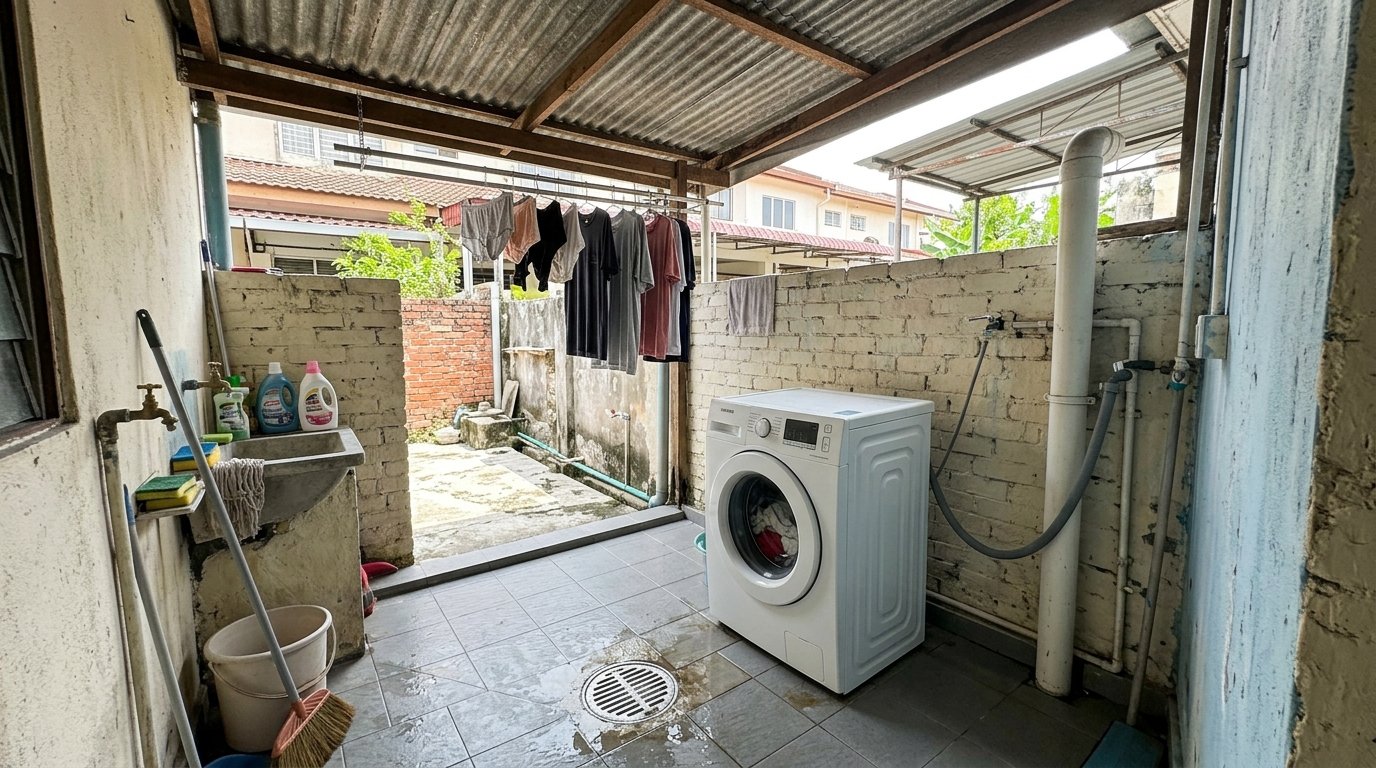
A permanently wet back laundry area almost always comes down to one of three things, and it pays to identify yours before spending anything: the floor was laid flat (or sloping away from the drain), the washing machine's drain hose is overwhelming or bypassing its outlet, or rain is getting in where the extension's metal-deck roof meets the original house. Most of the terrace-house back extensions around Serdang, Seri Kembangan and Bangi were built as simple cement-screed add-ons, and a proper floor fall to the trap was rarely part of the deal — so the water you mop today is back tomorrow.
The one-pail test
Pour a pail of water in the middle of the laundry floor and watch it for two minutes. If it heads for the floor trap and the floor is dry-ish in an hour, your floor is fine — the water is coming from the machine connection or the roof, and you can skip the expensive part of this article. If it sits in a puddle, or worse, drifts towards the kitchen door or the back wall, the floor itself has no usable fall. That standing water is why the cement is stained black, why the area smells musty, and why mopping never ends.
The washing machine connection: done right, it is invisible
The most common thing we find behind houses here is the machine's drain hose just hooked over the edge of the floor trap, or jammed straight down into it. A modern machine pumps out a surge of water faster than most floor traps can swallow, so it backs up and floods the floor around the trap every cycle — and people blame the floor. The lasting setup is a standpipe: a vertical 40 mm pipe, open at the top, rising about 60–90 cm off the floor, connected into the drain line. The hose hooks loosely into the top — never sealed tight, because the machine needs an air gap or it will siphon itself empty mid-cycle. If your hose is lying on the floor or balanced on the trap grating, fixing this one detail often ends the "wet floor" complaint entirely. It is a straightforward plumbing visit in the RM 100–500 range.
Rain getting in at the roof joint
If the area is wet mainly after storms, look up before you look down. Back-extension roofs are usually metal deck or zinc sheets run up to the original rear wall, and two spots fail first: the screw points (the rubber washers under the screw heads perish after 10–15 years of sun) and the joint where the sheet meets the wall, which was often finished with just a cement fillet or a bead of sealant. Both crack because the metal sheet expands and shrinks daily while the wall does not. Perished screws are a cheap half-day fix with new bonded washers; a failed wall joint needs proper flashing let into the brickwork, not another layer of sealant on top of the old one — that is the quote-comparison trap to watch for.
Fixing the floor itself: honest options
| Situation | Sensible fix | Scale of job |
|---|---|---|
| Hose on floor / trap overwhelmed | Proper standpipe and drain connection | Plumbing visit, RM 100–500 |
| One low spot ponds near the trap | Local patch-and-regrade of the screed | Half-day handyman job |
| Whole floor flat or back-falling | Re-screed with falls to the trap, then tile | Small reno, days not hours |
| Wet after rain only | Roof screws / wall flashing repair | Half-day to one day |
Here is the honest part: a full re-screed and retile of a laundry area is real wet-works — the old surface gets scarified or hacked, a new screed is laid with a continuous fall of about 1:80 to the trap, and non-slip tiles go on top. It is a mini version of what we do in a bathroom refresh (RM 3–8k for a full bathroom), and an open laundry floor is usually a fair bit less because there is no waterproofing membrane, wall tiling or sanitaryware involved. But do not let anyone retile directly over a flat screed without correcting the fall — you will pay for new tiles and keep the old puddle.
Start small, in this order
- Fix the washing machine standpipe and make sure the trap grating is not clogged with lint — lint is the silent killer of laundry-area drains.
- Replace perished roof screws and check the wall joint before the next monsoon stretch.
- Only then judge the floor with the pail test, and price the regrade or re-screed against how much the wet floor actually bothers you.
If you want one visit to sort the standpipe, screws and sealant together, that is exactly the sort of bundled half-day our handyman service does well — and if the floor does need proper re-screeding, our price guide shows the ranges so you can sanity-check any quote, including ours.
Facing this problem at your home or shop?
WhatsApp us a photo — honest answer within 1 working hour. Serving Serdang, Seri Kembangan, Kajang & Puchong.
WhatsApp 013-940 0355