Guides ·
The water tank on your roof: cleaning, the ball valve, and when to replace it
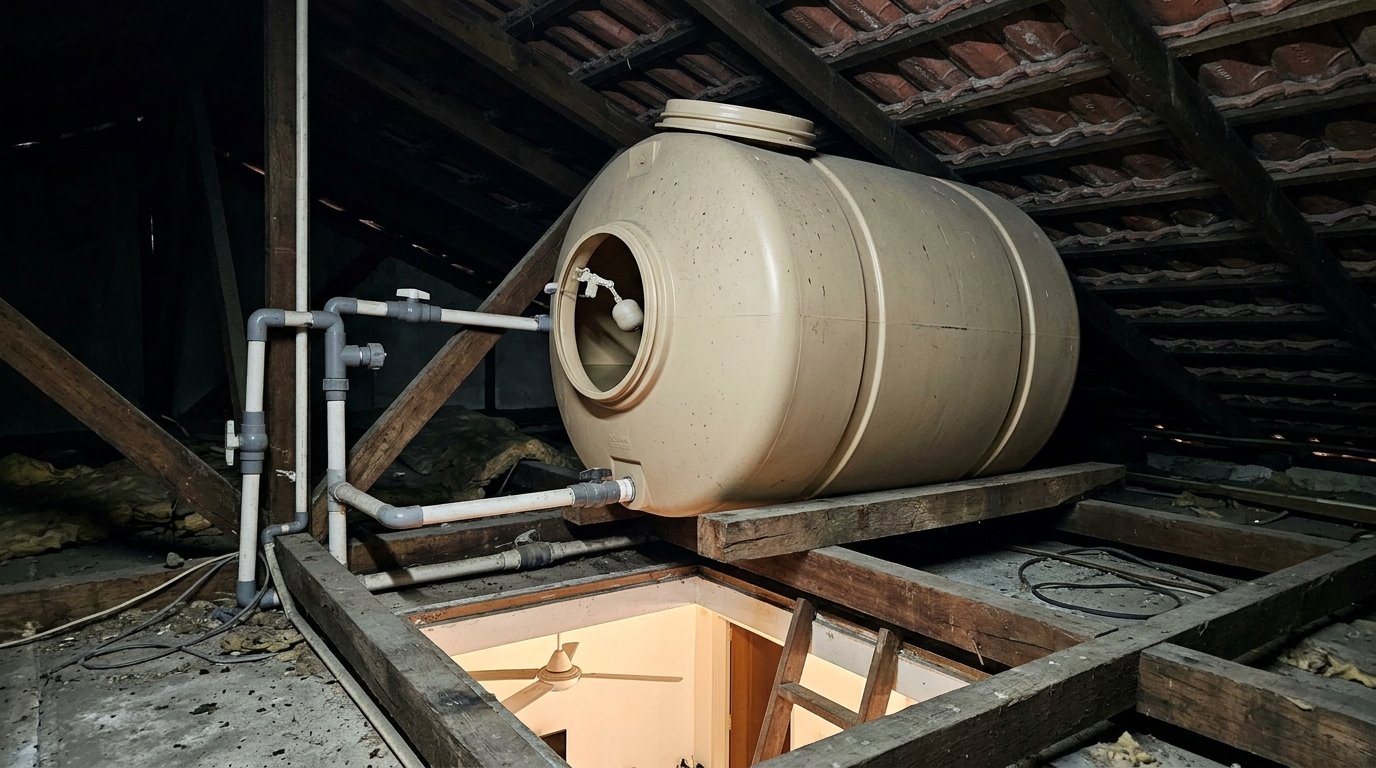
Quick answer: your roof tank deserves a look inside once a year and a proper clean-out every two to three years; the little float-operated ball valve inside it is a cheap part whose worn washer causes most mystery drips from the overflow pipe under the eaves; and the tank itself is worth replacing once an old fibreglass unit turns brittle and starts weeping at the seams — which, in houses around Serdang, Seri Kembangan and Kajang built in the 80s and 90s, is often years overdue. Servicing sits comfortably inside the usual RM 100–500 plumbing range; a new polyethylene tank installed runs roughly RM 700–1,600 depending on size and how hard it is to get up there.
The most neglected thing in the house
Most homeowners have never once seen inside their own water tank. It sits above the ceiling, out of sight, quietly feeding the showers, toilets and back-kitchen taps, and the only time it announces itself is when something goes wrong: a steady drip from a small pipe poking out under the roof edge, murky water after a supply interruption, or a damp stain spreading on the ceiling directly below it. All three are worth acting on early, because everything up there is cheap to fix and expensive to ignore.
That drip from the overflow pipe is the ball valve talking
The ball valve — the float on an arm — is supposed to shut off the incoming supply when the tank is full. When its rubber seat washer hardens and wears, it never quite closes. The tank keeps trickling full, and the excess runs out through the overflow pipe, day and night. Two things follow: your water bill creeps up month after month, and the constantly wet fascia board under that drip starts to stain and rot. The repair itself is a washer or a complete valve swap — minutes of work once someone is actually up at the tank. Access, not the part, is the real job.
What is actually sitting in the bottom of your tank
Open a tank that has never been cleaned and you will find a soft layer of fine sediment, and often a green film on the walls. Old fibreglass tanks are slightly translucent — enough light gets through for algae to grow. Every time the supply is disrupted and comes back, the incoming rush stirs that sediment up, which is why taps run cloudy after an interruption. Sediment also collects on the outlet strainer, and one thing we see repeatedly: a weak shower blamed on pipes or pressure clears up completely after nothing more than a tank clean-out.
Costs at a glance
| Job | Rough cost | When it is needed |
|---|---|---|
| Ball valve washer or full valve replacement | RM 100–250 | Overflow pipe dripping, bill creeping up |
| Tank clean-out and check | RM 150–350 | Every 2–3 years, or after murky water |
| New polyethylene tank, installed | RM 700–1,600 | Old fibreglass tank brittle, leaking or algae-stained |
When replacement is the honest answer
Signs the tank itself is finished:
- The fibreglass has gone brittle — it creaks or cracks around the fittings when handled.
- Greenish, translucent walls that regrow algae within months of every clean.
- Weeping at the seams or around the outlet fitting, showing as a damp ceiling patch below.
- The cover is warped, cracked or went missing years ago, letting in light, dust and insects.
Modern two-layer polyethylene tanks are opaque, so algae simply cannot grow, and they come with proper insect-proof covers. One thing worth checking during any replacement: the timber bearers the tank sits on. A full tank weighs several hundred kilograms, and thirty-year-old timber that has been dripped on for a decade should be inspected, not assumed.
A word about going up there yourself
Tank access is usually through a ceiling manhole into the roof space. If you go up, step only on the truss timbers — never on the plaster ceiling between them, because it will not hold a person. Go in the morning: a Malaysian roof space in mid-afternoon is brutally hot, and feeling dizzy at the top of a ladder is how small jobs become hospital visits. If any of that gives you pause, this is genuinely one of the cheapest jobs to hand over — a tank check fits easily into a normal plumbing or handyman visit, and our price guide shows what to expect before anyone climbs a ladder.
Facing this problem at your home or shop?
WhatsApp us a photo — honest answer within 1 working hour. Serving Serdang, Seri Kembangan, Kajang & Puchong.
WhatsApp 013-940 0355