Guides ·
Your bathroom is leaking into the unit downstairs: who pays and what actually fixes it
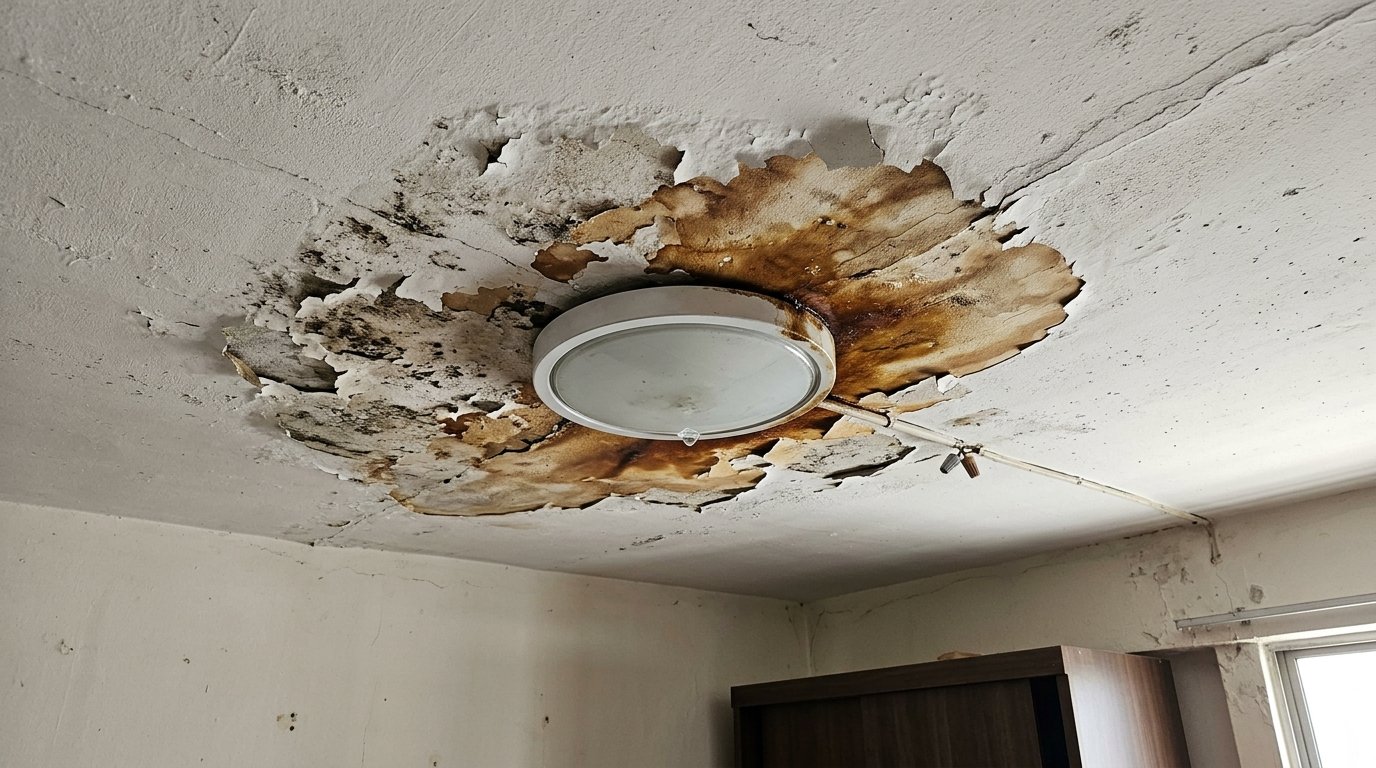
Straight answer: if water from your bathroom is staining the ceiling of the unit below, in most Malaysian strata buildings the upper unit owner pays — and the only fix that lasts is re-doing the waterproofing on your own bathroom floor, typically RM 1,500–5,000. Patching or repainting your neighbour’s ceiling fixes nothing: the water is still coming through the slab, and the stain will be back within weeks.
We see this dispute regularly in the apartments and flats around Seri Kembangan, Serdang and Balakong, and it sours neighbour relations fast — usually because both sides are guessing. Here is how responsibility actually splits, how to confirm what is really leaking, and what a proper repair involves.
Who pays: the short version
Under Malaysia’s strata rules, anything that serves your parcel alone is yours to maintain: your bathroom floor and its waterproofing membrane, your toilet, your shower, and the pipes feeding only your unit. The management body (JMB or MC) is responsible for common property — the main soil stacks and shared risers that serve more than one unit.
The strata management regulations even set out a standard process for inter-floor leakage: the affected owner complains to management, management inspects and issues a certificate stating the cause, and the leak is presumed to come from the upper unit unless shown otherwise. So if your downstairs neighbour reports you, don’t take it personally — the process genuinely starts with your floor. The flip side: if the inspection traces it to a common pipe cast into the slab, that repair belongs to management, not you.
First, confirm what is actually leaking
“Bathroom leak” covers three very different problems with very different price tags. Fifteen minutes of testing saves you from paying for the wrong repair.
- Meter test (supply pipes). Close every tap and valve in your unit, then watch the water meter for fifteen minutes. If it still creeps, a pressurised pipe is leaking — a plumbing job (RM 100–500), not waterproofing.
- Dye test (toilet and floor trap). Put food colouring in the cistern; if colour seeps out around the base of the bowl, the seal under the toilet has failed. A second dose of dye poured straight into the floor trap tells you whether that connection is the culprit.
- Ponding test (the membrane). Block the floor trap, fill the floor with 2–3 cm of water, mark the level and leave it for 24 hours. If the stain downstairs grows while your water level drops, the waterproofing has failed. Any serious contractor will insist on this test — it is the only way to prove the membrane, and a quote that skips it is guessing.
One trade detail worth knowing: the stain downstairs is rarely directly under the leak. Water tracks along the slab and the steel inside it, then drips at the lowest point — very often the neighbour’s ceiling light fitting, which is why they panic. Never let anyone locate the repair based on stain position alone.
Why the real fix is on your floor, not their ceiling
Waterproofing is a membrane under your tiles. In blocks that are fifteen or twenty years old it fails from age, hairline movement cracks, or a past renovation that drilled through it — and once it has failed, no sealer brushed on the ceiling below will hold against water arriving from above. From our own jobs, the failure point is almost never the middle of the floor: it is the floor-to-wall junction and the collar around the floor trap, which is exactly where cheap original workmanship cuts corners.
A proper repair means hacking up the floor tiles, making good the screed, applying a new membrane turned up the walls at least 150–300 mm, sealing properly around the floor trap, then repeating the ponding test before a single new tile goes down. Allow roughly a week including curing time.
| Finding | Test that confirms it | Typical fix | Honest range |
|---|---|---|---|
| Pressurised supply pipe | Meter test | Plumbing repair | RM 100–500 |
| Toilet base / floor trap seal | Dye test | Re-seat and re-seal | RM 100–500 |
| Failed floor membrane | Ponding test | Re-waterproofing + re-tiling | RM 1,500–5,000 |
Keeping the peace while it gets fixed
- Photograph the downstairs damage and your own bathroom, with dates, from day one.
- Inform management early and in writing — a WhatsApp message counts. If a common pipe is involved you want that on record.
- Run the tests above before any money changes hands, and share the results with your neighbour.
- Once your floor is fixed and the ponding test passes, offering to repaint their ceiling patch is cheap goodwill — far cheaper than a tribunal case between neighbours who still share a lift.
If you are in an apartment around Serdang, Seri Kembangan or Balakong and the unit below has just sent you that photo of their ceiling, we can run the tests, give you a written finding for management, and quote the repair honestly — our price guide shows the full ranges before you ever call.
Facing this problem at your home or shop?
WhatsApp us a photo — honest answer within 1 working hour. Serving Serdang, Seri Kembangan, Kajang & Puchong.
WhatsApp 013-940 0355