Guides ·
Toilet cistern running non-stop: the RM 20 fix for a rising water bill
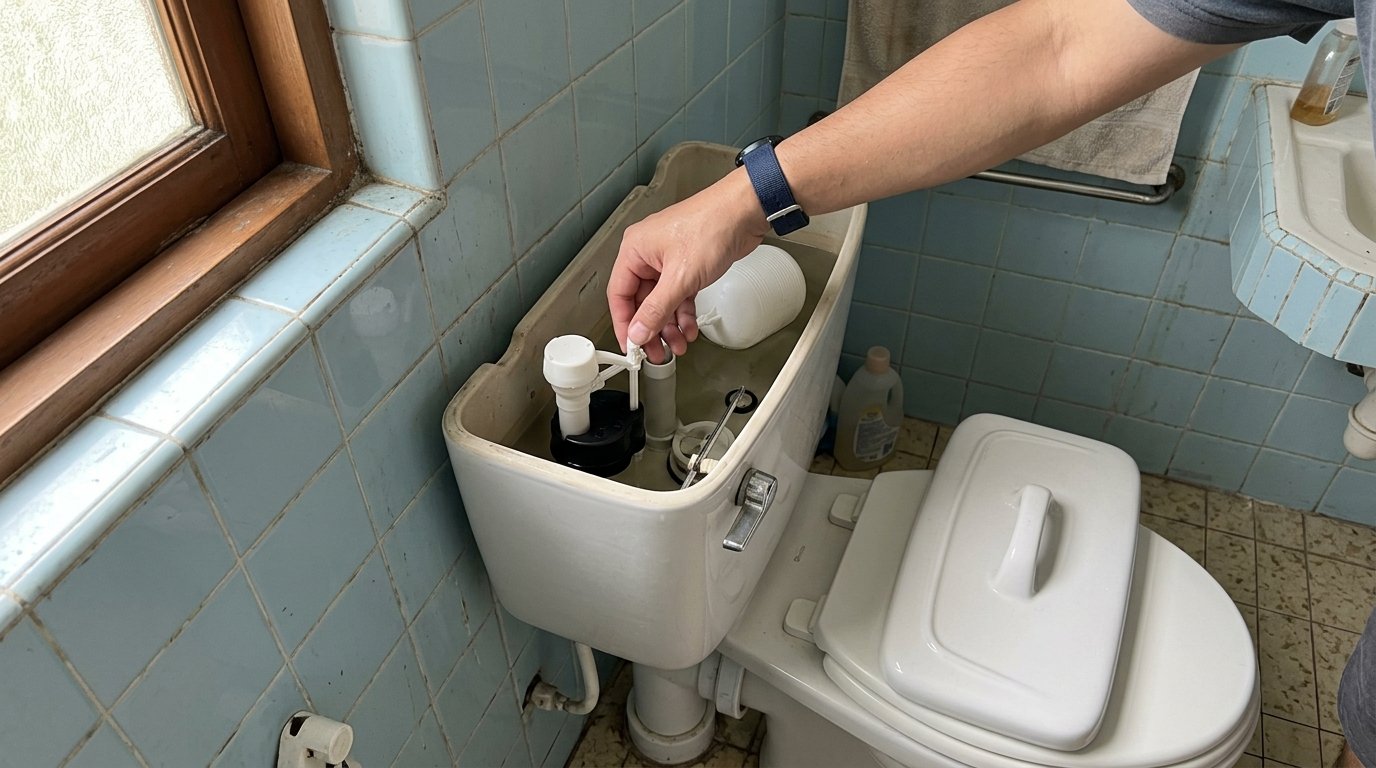
A cistern that refills by itself every few minutes, or hisses quietly long after you flush, is leaking water straight into the bowl — slowly, silently, around the clock. On a metered supply that shows up as a water bill creeping up month after month for no visible reason. The good news: in most cases the culprit is a RM 10–30 rubber part or a float set too high, and you can work out which one it is in five minutes without a single tool.
First, listen
Two different sounds point to two different problems:
- A hiss from the inlet side that never quite stops means the fill valve is still letting water in — usually a float problem.
- A silent trickle down the back of the bowl (look for a faint shimmer moving on the porcelain) means the flush valve seal at the bottom of the tank is letting water through.
The five-minute food-colouring test
- Lift the cistern lid and add a few drops of food colouring to the tank water — or, honestly, a spoon of Milo works fine.
- Do not flush. Wait 20–30 minutes.
- Colour appearing in the bowl means the flush valve seal is leaking. If instead the water level slowly climbs to the top of the overflow tube, the inlet valve or float is the problem.
Fix 1: the float is set too high
Every cistern has an overflow tube as a safety drain. If the fill valve tops the water up above that tube, water pours down it into the bowl continuously — and the valve keeps refilling forever. The waterline should sit about 2–3 cm below the top of the overflow tube. Modern plastic fill valves have an adjustment screw or a sliding clip on the float; the brass ball-cock arm in older cisterns just bends gently downward.
One note from the field: after a water supply disruption — and the Klang Valley gets its share — grit carried in with the restored supply often lodges in the fill valve seat. A cistern that starts hissing right after a water cut is usually dirty, not broken: shut the angle valve beside the toilet, open the fill valve cap, rinse the little washer and its seat, and reassemble.
Fix 2: a worn flush valve seal
Rubber sitting in warm water for years hardens and warps, and eventually the flat seal under the flush valve no longer sits flat. On most modern cisterns the fix is genuinely easy: shut the angle valve, flush to empty the tank, twist out the flush valve cartridge (most are a quarter-turn bayonet fitting), swap the rubber seal, and wipe any scale off the plastic seat it lands on — a gritty seat will leak even with a brand-new seal. The seal costs RM 10–30 at any hardware shop; bring the old one to match it.
If your house still has an older siphon-type cistern — the kind with a full-stroke lever that lifts water over an internal bell — a running tank is almost never its fault, because a siphon physically cannot leak into the bowl once the flush ends. Siphon cisterns fail the other way, with a weak or incomplete flush.
When the honest answer is a full internals set
Cistern plastic goes brittle after 15–20 years. Lugs snap as you remove the cartridge, the brand no longer exists, and no shop stocks the odd-sized seal. At that point stop hunting for parts: a complete set of new internals — fill valve plus flush valve — costs RM 40–80 and fits almost any standard cistern.
| Fix | Part cost | DIY? |
|---|---|---|
| Adjust the float | RM 0 | Yes — five minutes |
| Rinse grit from fill valve | RM 0 | Yes, if there is an angle valve to shut |
| Replace flush valve seal | RM 10–30 | Yes on most modern cisterns |
| Full internals set | RM 40–80 | Confident DIYers — an hour of work |
| Plumber visit | RM 100–500 range; this job sits at the lower end | — |
Call a plumber instead of persevering when there is no angle valve to shut off (some older bathrooms tee straight off the pipe), when the cistern bolts on a close-coupled toilet have rusted solid, or when the cistern is concealed behind tiles — forcing any of those turns a RM 20 job into a broken-porcelain job.
Why fix it this week, not someday
A leaking flush seal passes water 24 hours a day, every day, and unlike a dripping tap you cannot see or hear most of it. Over a full billing cycle even a slow trickle adds up to real money — this is one of the most common findings when we chase an unexplained bill increase. If your bill has already jumped and the cistern checks out clean, the leak may be elsewhere in the piping: our price guide shows what plumbing visits typically cost, and our services page covers call-outs around Serdang, Seri Kembangan, Kajang, Bangi and Puchong.
Facing this problem at your home or shop?
WhatsApp us a photo — honest answer within 1 working hour. Serving Serdang, Seri Kembangan, Kajang & Puchong.
WhatsApp 013-940 0355