Guides ·
Water-stained gypsum ceiling: patch one panel or replace the whole stretch?
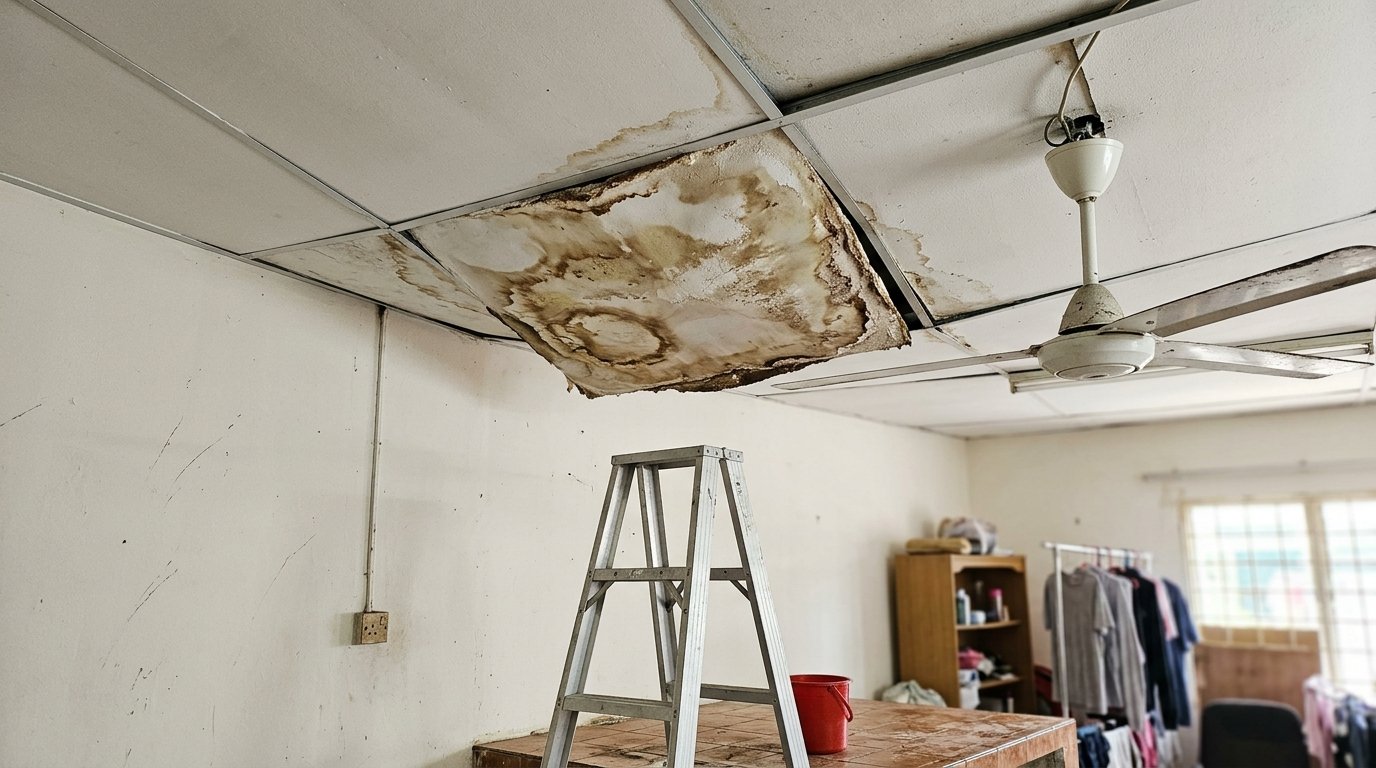
Here is the short answer. Take a broom handle and push gently on the stained board. If the panel is still flat, hard and sitting tight, the board itself is fine — you only need a stain-block primer and a repaint. If it flexes like cardboard, feels soft, or has already sagged into a visible belly, that panel has to come out. A gypsum board that has been soaked never flattens again, no matter how many weeks you point a fan at it.
One condition before any making-good: the leak above must actually be fixed, not just quiet. Pencil a line around the edge of the stain and check it after the next two heavy rains — if the mark grows or darkens, you are still leaking. And if the room above is a bathroom, the usual culprit is failed floor waterproofing, which is a re-waterproofing job, not a ceiling job. Patch the ceiling first and you will pay for the same panel twice.
Why a soaked board never recovers
A gypsum board is compressed plaster powder held between two paper skins, and the paper is what gives it stiffness — like the skin of a drum. Soak it and two things happen: the core goes soft and slumps under its own weight between the furring channels, and the paper delaminates from the core. When it dries, the core re-hardens in the sagged shape, crumblier than before, and screws no longer bite properly. That is why “wait for it to dry and paint over” works for a light stain but never for a sag.
Patching one panel, done properly
Most terrace-house ceilings around Serdang, Seri Kembangan and Kajang hang on metal furring channels at roughly two-foot spacing, so a clean patch means cutting the damaged section back to the centreline of the nearest channels, screwing in a new piece, taping the joints and skimming. The detail that separates a good patch from a lazy one is skim width: the compound has to be feathered 200–300 mm past the joint and sanded flat. Skim only to the cut edge and you get the classic “picture frame” — a rectangular shadow invisible at noon that shows up every evening when light rakes across the ceiling.
Budget for repainting the whole ceiling, not just the patch. A ceiling that has been up ten years is no longer the same white as fresh paint, and a touched-up rectangle reads almost as badly as the stain did.
When replacing the run makes more sense
- The sag crosses a joint into neighbouring boards — the deformation rarely stops neatly at your cut line.
- There is mould on the hidden top side. Put your phone through the opening and take a photo; a slow leak that ran for months often grows a black carpet up there, and a patch would seal it in.
- Several separate stains along one pipe run — chasing them one by one costs more than a single clean re-sheet.
- The ceiling is 25–30 years old and brittle: every screw you drive near the old boards pops another blister of paint, and the “one panel” job grows on its own.
A rule of thumb from the jobs we see: once more than about a third of a room is affected, re-sheeting the whole ceiling is usually neater and not much dearer than three separate patches.
The stain that keeps coming back
Water stains are not just dirt. The water pulls tannins and mineral salts through the board, and ordinary emulsion paint is water-based — it re-wets the stain and lifts it straight back through, usually within weeks. The fix costs RM 20–40: one coat of a solvent- or shellac-based stain-block primer before the emulsion. Two extra coats of plain white on top do nothing except delay the ghost.
Careful with older ceilings
Not every flat ceiling is gypsum. Plenty of 1980s houses in the Serdang belt have hard, thin grey cement sheets nailed to timber battens, and some sheeting of that era contains asbestos. Tell-tales: grey right through with no paper face, nailed rather than screwed, and it snaps with a sharp crack instead of crumbling. Do not cut, drill or sand it — have it identified and handled by people equipped for it. This is one of the few ceiling jobs where DIY is genuinely the wrong call.
What it costs
| Job | Typical range |
|---|---|
| DIY: stain-block primer + paint for one stain | RM 60–120 (materials) |
| Handyman patch: one panel cut out, re-boarded, skimmed, primed | RM 250–600 |
| Replace a run of boards incl. repainting the ceiling | RM 600–1,500 |
| Re-sheet a whole small-room ceiling | RM 1,200–2,800 |
Ranges move with access (double-volume areas need scaffolding), cornice work and how much repainting is included. Ask the quote to spell out the skim width and whether the whole ceiling gets painted — those two lines are where cheap quotes hide their shortcuts.
If you would rather have one visit confirm the leak is dead and make good the ceiling in the same trip, that is exactly the kind of job we bundle — see our services.
Facing this problem at your home or shop?
WhatsApp us a photo — honest answer within 1 working hour. Serving Serdang, Seri Kembangan, Kajang & Puchong.
WhatsApp 013-940 0355