Guides ·
Old house wiring: the signs it actually needs rewiring (and the ones that don't)
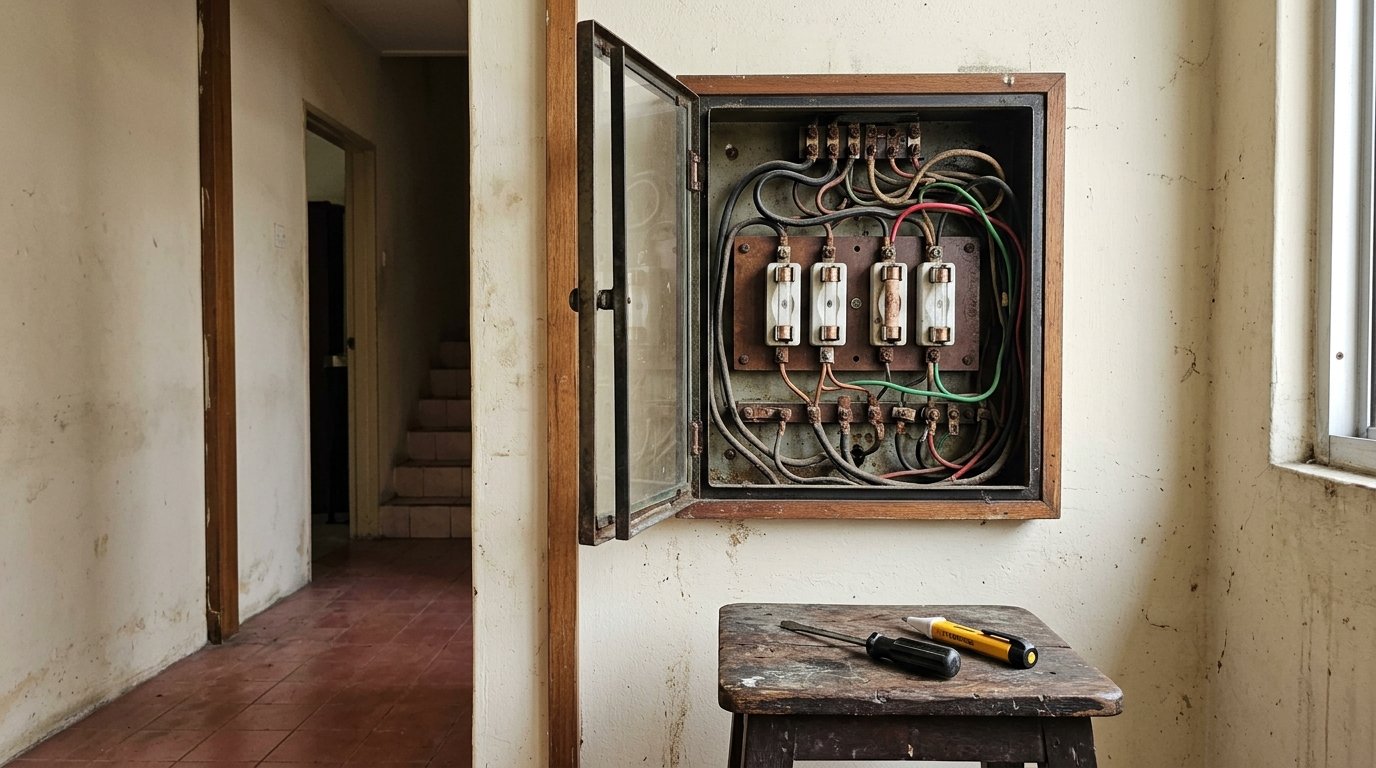
Straight answer: most electrical problems in an older house are point repairs — one worn socket, one loose connection, one tired breaker — and they sit in the normal RM 80–600 repair band. A house genuinely needs rewiring only when the cable insulation itself has aged beyond saving, or when whole circuits were built with no earth wire. Age on the calendar alone is not a verdict: we have seen 1980s Seri Kembangan terrace houses whose original PVC wiring still tests fine, and much younger houses in Balakong turned into a mess by thirty years of ad-hoc extensions.
One rule before anything else: every wiring job we arrange is carried out with our licensed partner contractor, Suruhanjaya Tenaga compliant. Nothing below is an invitation to open a switchboard yourself — the point of this article is to help you read the symptoms, so you know what kind of conversation to have.
Signs that usually mean a repair, not a rewire
- One dead or loose socket. Almost always a worn socket or a loose termination behind that single plate.
- One warm switch plate. Usually a loose screw terminal arcing quietly behind that one switch. A one-visit fix — but stop using the switch until it is checked, because loose terminals only get looser.
- The breaker trips only when one appliance runs. Suspect the kettle, iron or water heater, not the house.
- A flickering light or one dim room. Starters, drivers and single loose joints, not whole-house cabling.
All of these are typical RM 80–600 visits. A contractor who hears “one warm switch” and immediately quotes a full rewire is selling, not diagnosing.
Signs that start the rewiring conversation
- Black rubber or cloth-covered cable. Pull-era insulation from the 1970s and earlier goes hard and crumbles the moment anyone flexes it. You cannot patch a cable whose whole length is perished — every junction box touched becomes a new fault.
- No earth wire at sockets and light points. Many older two-wire circuits simply have nothing to carry a fault to ground, which means an ELCB or RCCB cannot protect you properly even if one is fitted.
- A rewirable fuse box. Porcelain carriers with fuse wire instead of a modern MCB and RCCB board date the whole installation, and usually everything behind it.
- Problems in several rooms at once. Warm plates here, a browned socket face there, a faint hot-plastic smell somewhere else — scattered symptoms on different circuits suggest the insulation is failing generally, not one bad joint.
A trade habit worth knowing: insulation fails fastest where cables run hottest, so the first places our partner checks in a Serdang-belt terrace are the ceiling space above the kitchen and the circuits feeding the water heater and air-conditioners. And the honest arbiter is not anyone’s opinion — it is an insulation-resistance test (the “megger” test), which puts a number on how much life the cables have left.
Quick decision table
| Symptom | What it usually is | Repair or rewire? |
|---|---|---|
| One dead socket | Worn socket or loose termination | Repair, RM 80–600 |
| One warm switch plate | Loose terminal behind the plate | Repair — check promptly |
| Trips with one appliance | Appliance fault | Repair or replace the appliance |
| Crumbling black or cloth cable | Perished insulation | Rewire that circuit at minimum |
| No earth at sockets | Two-wire era circuits | Rewiring conversation |
| Porcelain rewirable fuses | Pre-MCB installation | Board upgrade, then test circuits |
What rewiring actually involves
A rewire is disruptive but not mysterious: new cables chased into the walls (or run in surface trunking where you want to avoid hacking), a new consumer unit with proper MCBs and an RCCB, and earthing brought up to current standards. In an occupied terrace house the work is often phased — one floor or a few circuits at a time — so the family keeps lights and a fridge running throughout. Done with our licensed partner contractor and tested circuit by circuit before handover, Suruhanjaya Tenaga compliant.
Our honest advice
Do not panic-buy a rewire from whoever knocked on the door. If your house shows any of the second list, book an inspection with insulation testing and make the decision on numbers, not fear. If it only shows the first list, fix the fault and move on — that is what our electrical repair service is for, and you can sanity-check the cost against our price guide first. The one thing never worth postponing: a burning smell or scorch marks at any outlet means switch that circuit off at the board and have it looked at before using it again.
Facing this problem at your home or shop?
WhatsApp us a photo — honest answer within 1 working hour. Serving Serdang, Seri Kembangan, Kajang & Puchong.
WhatsApp 013-940 0355