Guides ·
Leaking bidet spray: the RM 30 fix everyone keeps postponing
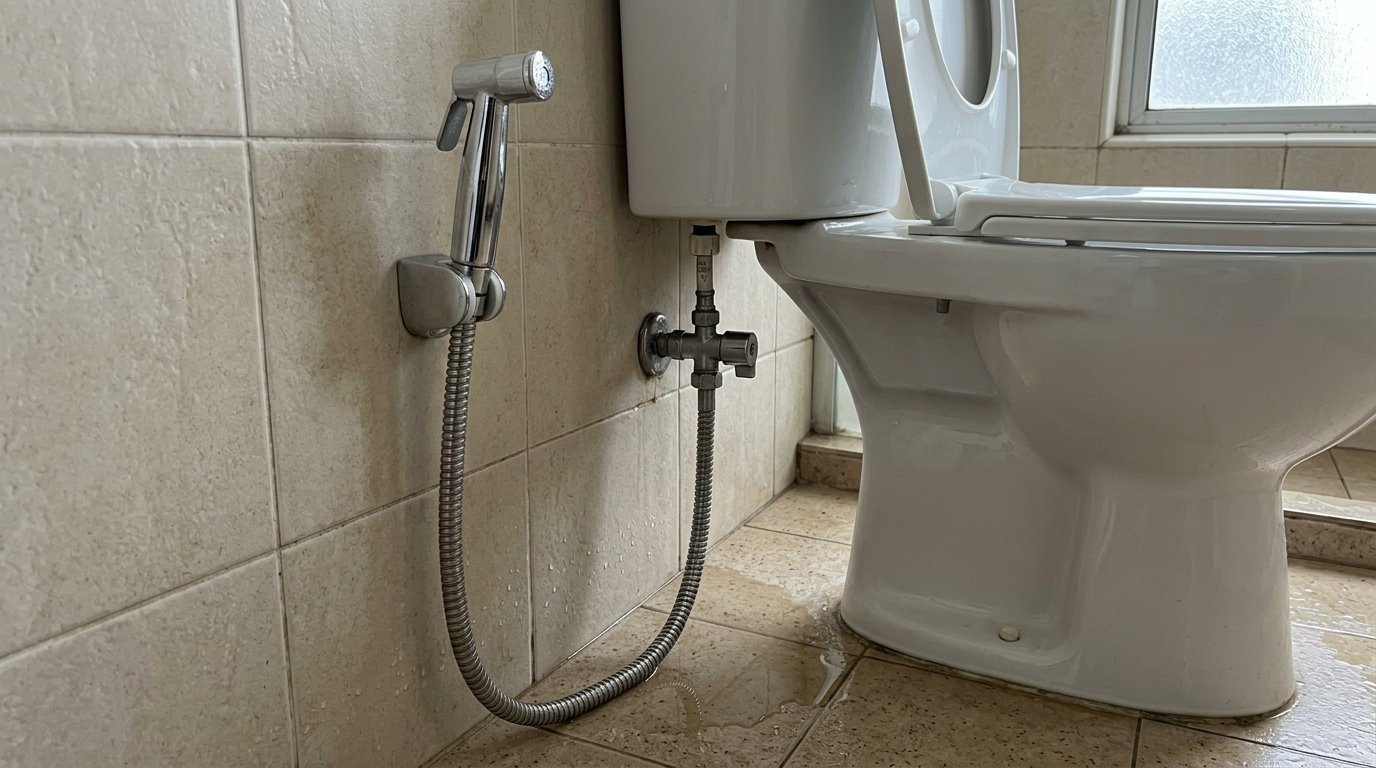
If your bidet spray drips, the culprit is almost always one of three cheap parts: the spray head itself (RM 15–40), the hose (RM 10–25) or the T-valve beside the cistern (RM 15–35). All three are 15-minute DIY swaps with a roll of thread tape from any hardware shop. But here is the part most people miss: that drip is also a warning, because a bidet hose sits under full mains pressure 24 hours a day — and it is a burst hose, not the drip, that floods bathrooms.
Step 1: find out which part is leaking
Dry everything with a cloth, then watch for a minute. The leak will show itself in one of three places:
- Dripping from the nozzle when nobody is pressing it — the rubber seal inside the trigger head is worn out. Replace the head.
- Water weeping along the hose or at the metal crimp ends — the hose has perished. Clear PVC hoses turn yellow and brittle within two or three years in Malaysian heat; once you see hairline cracks near the crimp, it is living on borrowed time.
- Drips at the T-shaped fitting below the cistern — the T-valve nut is loose or its thread tape has given up. Sometimes the valve body itself has cracked, especially the shiny zinc-alloy ones sold for a few ringgit less; brass lasts far longer.
The 15-minute DIY swap
- Close the T-valve lever (or the angle valve at the wall), then press the spray trigger to release the pressure trapped in the hose.
- Unscrew the old part. Spray heads and hoses use a standard half-inch thread, so almost any replacement in Serdang or Seri Kembangan hardware shops will fit.
- The head-to-hose and hose-to-valve joints seal with the rubber washer inside the nut — no tape needed, just check the washer is seated flat. Only the T-valve’s threaded joint into the cistern inlet needs thread tape: four to six turns, wrapped in the same direction you will screw it on.
- Tighten hand-tight plus a gentle quarter turn. Plastic nuts crack when you lean on them with pliers — that is how a RM 30 job turns into a RM 300 one.
Spend the extra few ringgit while you are at it: a stainless-steel braided hose and a brass T-valve typically outlast three sets of the budget PVC-and-zinc versions, and the price difference is less than a plate of char kuey teow.
The habit that prevents a flood: close the T-valve
This is the advice we repeat on every plumbing call. The hose holds mains pressure around the clock whether you use the spray or not. In apartments around Seri Kembangan and Balakong — where lower floors get noticeably higher pressure — a hose that lets go while you are at work can run for hours and soak the unit below yours too. Closing the small lever on the T-valve after use takes five seconds and costs nothing. At minimum, close it before you travel or balik kampung.
What the parts cost
| Part | Typical price | Worth knowing |
|---|---|---|
| Spray head (trigger type) | RM 15–40 | Metal-bodied heads outlast plastic ones |
| Braided stainless hose | RM 10–25 | Skip clear PVC — it hardens within 2–3 years |
| T-valve (brass) | RM 15–35 | Avoid zinc-alloy; it corrodes and cracks |
| Complete set | RM 30–60 | Easiest fix if you are unsure which part failed |
When it is genuinely a plumber’s job
If the angle valve at the wall is seized with corrosion and will not turn, or your older terrace house still has galvanised iron pipework whose threads crumble when disturbed, stop there. Forcing a seized valve can snap the stem and send mains water across the bathroom — now it is an emergency. That is a small plumbing job in the RM 100–500 range, and we handle repairs like this across Serdang, Seri Kembangan, Balakong, Kajang, Bangi and Puchong, usually same-day. But if it is just the head, hose or T-valve? Honestly, do it yourself — you do not need us for that one.
Facing this problem at your home or shop?
WhatsApp us a photo — honest answer within 1 working hour. Serving Serdang, Seri Kembangan, Kajang & Puchong.
WhatsApp 013-940 0355