Guides ·
Ceiling paint bubbling or flaking after a leak: why repainting alone fails
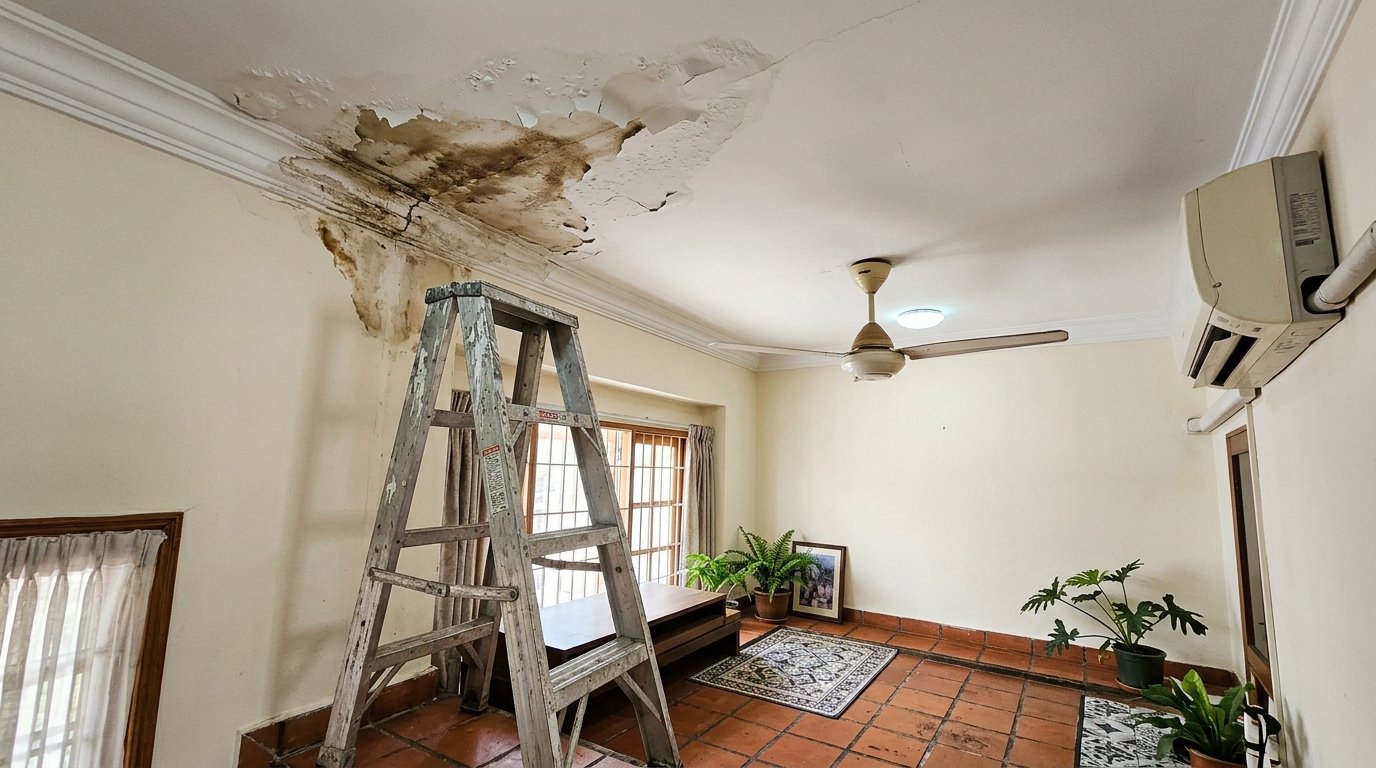
If paint is bubbling or flaking off your ceiling after a leak, the paint is not the problem — moisture is. Repaint over a damp slab and the new coat will bubble again within two or three months, because water still trapped in the concrete keeps pushing its way out through the film. The fix that actually lasts has four steps in strict order: kill the leak, let the slab dry properly, seal the stain, then repaint. Skip any one of them and you will be repainting the same patch again by next year.
Step 1: make sure the leak is actually dead
On double-storey terraces around Serdang, Seri Kembangan and Bangi, a bubbling ceiling under a bathroom almost always means the waterproofing membrane upstairs has failed — and no amount of paint downstairs can outrun that. The way to confirm it is a ponding test: block the upstairs floor drain, hold a few centimetres of water on the bathroom floor, mark the level, and check after 24 hours. If the level drops or the ceiling stain darkens, the membrane is gone. That is a re-waterproofing job in the RM 1,500–5,000 range, done from above by hacking and re-laying the floor — not a painting job at all.
If the stain sits under the roof instead, compare its behaviour: grows after heavy rain means roof tiles, flashing or a blocked gutter overflowing into the eaves; grows after showers are used means plumbing or waterproofing. And a simple rule we use on site: a stain with a dark, wet-looking edge is still live, while an old dead stain is uniformly dry and tea-coloured.
Step 2: let it dry — longer than you think
A concrete slab holds a surprising amount of water. After the leak is fixed, give it two to four weeks to dry, with a fan on it and windows open if you can. The test for readiness costs nothing: tape a piece of plastic sheet or aluminium foil tightly over the patch overnight. Mist or droplets on the underside in the morning means the slab is still releasing moisture — wait, do not paint.
Plasterboard ceilings play by a different rule. Once a board has sagged or gone soft, it never flattens back as it dries; skimming over a sagged board just cracks along the same line. Cut out and replace the damaged section — it is a modest job and the only one that looks right afterwards.
Step 3: the sealer coat nobody skips twice
Water stains bleed straight through ordinary emulsion. Paint the patch white today and the brown ring ghosts back through within a week or two — this is the single most common reason people think the leak has come back when it has not. Scrape off every bit of loose, bubbled paint until you reach an edge that holds firm, feather-sand the edges, then prime the whole stained area with an oil- or solvent-based stain-blocking sealer. Only after that does your normal ceiling white go on.
What it costs
| Job | Typical cost |
|---|---|
| Scrape, seal and repaint a patch (DIY materials) | RM 50–100 |
| Handyman scrape-seal-repaint of a stained area | RM 150–400 |
| Replace a sagging plasterboard section, skim and paint | RM 200–600 |
| Re-waterproof the bathroom floor above | RM 1,500–5,000 |
When repainting alone is perfectly fine
Plenty of ceilings carry an old stain from a leak fixed years ago. If the surface is sound, the foil test comes up dry and the stain has not changed since you moved in, you genuinely do not need a contractor — a tin of sealer and a Saturday morning will do it. Where we earn our fee is the step before that: confirming whether the leak upstairs is actually dead. If you are not sure which case yours is, send us a photo through our services page and we will tell you honestly whether it is a DIY weekend or a waterproofing problem.
Facing this problem at your home or shop?
WhatsApp us a photo — honest answer within 1 working hour. Serving Serdang, Seri Kembangan, Kajang & Puchong.
WhatsApp 013-940 0355