Guides ·
Blocked toilet bowl: clear it safely without making things worse
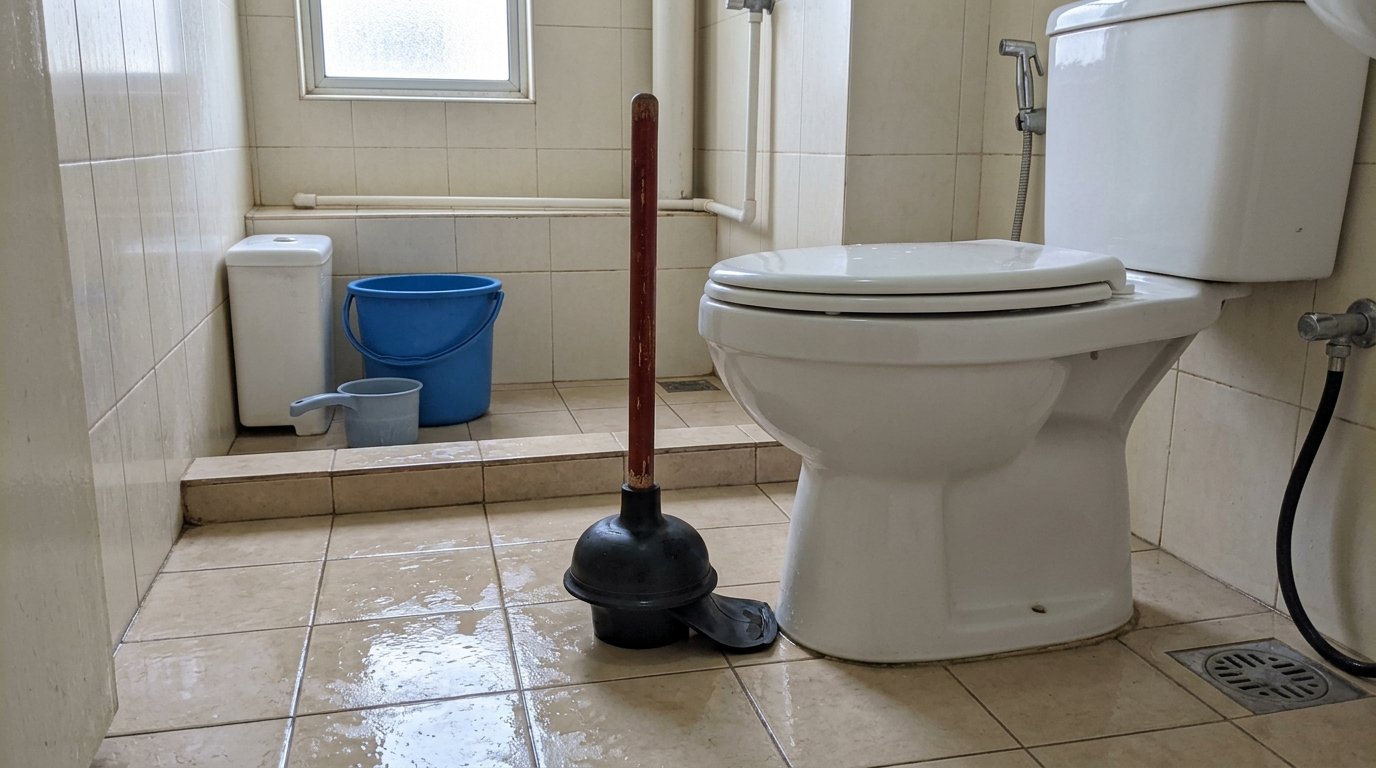
To clear a blocked toilet safely you need one tool and ten minutes of patience: a flange plunger — the type with a rubber sleeve that folds out from inside the cup. What you should not reach for is chemical drain opener. In a toilet trap it mostly sits in the bowl achieving nothing, and it turns every attempt after that into a chemical splash hazard. Here is the order of attack we would use in our own homes.
Use a flange plunger, not the flat sink type
The flat-cup plunger in most Malaysian homes is made for flat surfaces like sink drains. A toilet outlet is curved, so the flat cup never seals — you are just splashing water. A flange plunger’s fold-out sleeve fits into the outlet and holds a seal. Then the technique:
- Make sure there is enough water to cover the cup. If the bowl is nearly empty, add some — the plunger moves water, not air.
- First push slowly, to squeeze the air out of the cup without a splash.
- Then 15–20 firm push-pull strokes without lifting the cup. Here is the detail most people get wrong: the pull does as much work as the push. Rocking the blockage in both directions is what breaks it loose; most paper blockages give way within two rounds.
Why chemical drain openers backfire in a toilet
- The caustic liquid pools in the trap instead of reaching the blockage, and the heat it generates can craze the porcelain glaze.
- If it fails — and on wipes or an object it always fails, because caustic soda does not dissolve them — you now have a bowl of caustic water that you, or the plumber you call, must plunge through.
- A safer first step for a sluggish, slow-draining bowl: a squirt of dishwashing liquid and half a pail of hot (not boiling — sudden heat can crack cold porcelain) water, left for 15 minutes before plunging.
What never goes down the bowl
Almost every blockage we clear started with one of these:
- Wet wipes — including the ones labelled “flushable”. They do not break down; they rope together in the pipe. This is the single most common thing pulled out of blocked lines.
- Sanitary products and nappies.
- Cooking oil and food scraps — oil cools and hardens into a plug inside the underground line.
- Dental floss, hair, cotton buds, cat litter.
How to tell the blockage is past the toilet
Flush once and watch the bathroom floor trap. If water rises or gurgles there, the problem is downstream of the bowl, in the pipe — and no amount of plunging the bowl will fix it. In older terrace rows around Serdang and Seri Kembangan, the external sewer line along the back of the row is often shared: lift the small concrete inspection-chamber cover outside, and if it is full of standing water, the blockage is in the underground run — possibly even past your own boundary.
| What you see | Where the blockage likely is | Realistic fix |
|---|---|---|
| Bowl fills, drains slowly, other drains fine | In the bowl’s own trap | Flange plunger — DIY |
| Flushing pushes water up the floor trap | Pipe between bathroom and outside chamber | Plumber with a drain rod or auger |
| Outside inspection chamber full or overflowing | Underground shared line | Plumber; neighbours may share the cost |
When to stop and call someone
Two situations are worth a professional visit: the floor-trap or chamber signs above, or a toilet that blocks again every few weeks. Repeat blockages usually mean a partial obstruction — a toy or air-freshener cap lodged in the trap, or a bowl that was reset slightly off-centre from the outlet pipe during a past renovation — and it will keep happening until the cause is removed. A visit like that sits in the RM 100–500 plumbing range; see what our call-outs cover around Serdang, Seri Kembangan, Balakong, Kajang, Bangi and Puchong. But a one-off paper blockage? The RM 20 flange plunger wins — keep one in the house before you need it.
Facing this problem at your home or shop?
WhatsApp us a photo — honest answer within 1 working hour. Serving Serdang, Seri Kembangan, Kajang & Puchong.
WhatsApp 013-940 0355