Guides ·
Water pooling on the bathroom floor: bad slope and the real fix
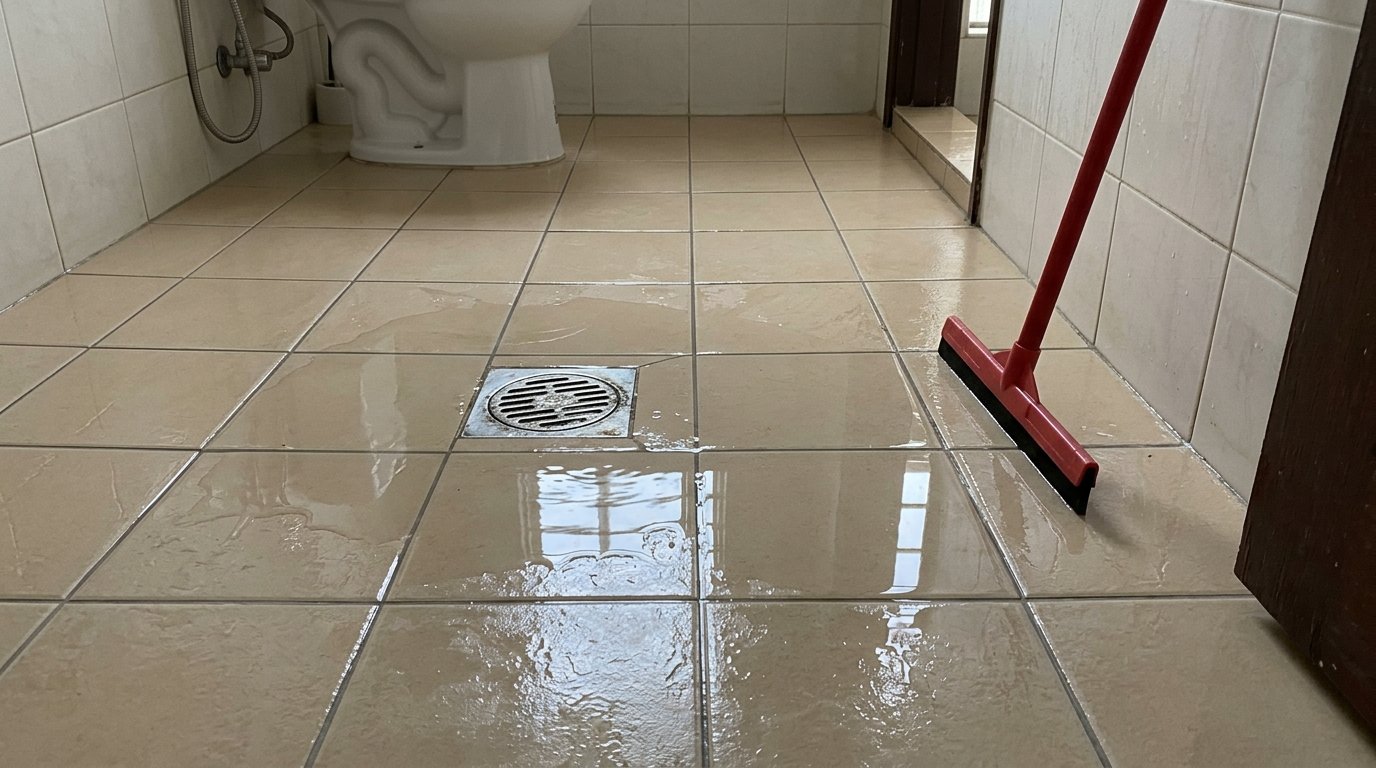
If water still sits in a puddle on your bathroom floor an hour after the last shower, the floor itself is the problem: the screed under the tiles was never given enough fall towards the drain. Mopping does not fix that, and neither does the drain-cleaning service you may be tempted to call — the drain is fine, the water just cannot reach it. The honest range of fixes runs from a ten-ringgit squeegee habit to re-screeding the floor with proper falls, which, because it means hacking up the tiles, is normally done as part of a bathroom refresh in the RM 3,000–8,000 range. Here is how to tell which end of that scale you are on.
A bathroom floor is not supposed to be level
Under the tiles sits a sand-cement screed laid with a deliberate slope — in the trade, a fall of about 1:80 to 1:100, meaning the floor drops roughly one centimetre for every metre of run towards the floor trap. On paper, every terrace house bathroom in Serdang, Seri Kembangan or Kajang was built this way. In practice, screeds are one of the most rushed jobs on a construction site. We regularly open up bathrooms where the floor trap sits on a small hump with the floor falling away from it, or where a dead-flat patch near the door collects everything. The tiler then follows whatever screed he was given, and the puddle is built in for life.
The five-minute test
Pour a large bottle of water slowly onto the middle of the dry floor and watch. It should crawl towards the floor trap and be gone within a couple of minutes. If it splits up, wanders towards the door, or settles into a standing patch that is still there at lunchtime, you have a fall problem — and the position of that patch tells the contractor exactly where the screed is low.
Why ponding quietly kills the bathroom
A permanent puddle is more than a slipping hazard. Cement grout slowly erodes under standing water, and once water gets below the tiles it sits on the waterproofing membrane all day, every day. Membranes cope well with water that drains away; a 24-hour pond patiently finds every pinhole and weak corner. In our experience, the bathrooms that leak through to the downstairs ceiling earliest are almost always the ones with standing water — ponding is the single biggest early killer of waterproofing. The door frame tells the same story: a puddle that reaches the threshold is why so many bathroom doors and frames rot from the bottom up. If you are already seeing stains on the ceiling below, read our waterproofing page before spending anything on cosmetics.
Cheap fixes: what helps and what wastes money
| Fix | Rough cost | Verdict |
|---|---|---|
| Squeegee the floor after showers | RM 10–20 | Genuinely works if the ponding is mild — no shame in it |
| Extra floor trap at the low point | RM 100–500 plumbing range | Sometimes sensible on ground floors where the pipe run allows; rarely worth it upstairs, as cutting the slab disturbs waterproofing |
| Tile-over-tile to "re-slope" | Varies | Usually fails — a few millimetres of adhesive cannot create a real fall, and the floor ends up higher than the door threshold |
| Re-screed with proper falls | Part of RM 3,000–8,000 refresh | The actual fix — done once, done right |
What a proper re-screed involves
- Hack the tiles and old screed back to the concrete slab.
- Re-do the waterproofing — hacking destroys the old membrane, so anyone who skips this step is setting you up for a leak.
- Run a 24-hour ponding test to prove the new membrane holds before anything covers it.
- Lay the new screed with falls set towards the trap, checked with a level and a test pour — not by eye.
- Tile, grout and seal. Smaller or matt tiles follow a sloped wet floor better and grip better underfoot.
Done as part of a refresh, this is typically a five-to-ten-day job including curing and testing time.
Is it worth doing on its own?
Honestly: rarely. Because the tiles come up anyway, re-screeding alone costs a large share of a full refresh while giving you back the same old bathroom. Most owners fold it into a refresh — new floor, falls done properly, waterproofing renewed and tested in one go. Our price guide shows what the realistic ranges look like, and a quick site visit will tell you whether your puddle needs a squeegee or a screed.
Facing this problem at your home or shop?
WhatsApp us a photo — honest answer within 1 working hour. Serving Serdang, Seri Kembangan, Kajang & Puchong.
WhatsApp 013-940 0355